
Sloping Block House Designs: A Complete Guide to Building Your Dream Home

Published by Adeel Virk
Adeel is a founder & project manager at Virk Construction Management, delivering ethical, high-quality residential and commercial projects in NSW and Canberra.
The construction on a sloping block poses several special challenges and exceptional opportunities for Canberra and overall Australian homeowners. Although most individuals find sloping grounds a construction setback, skilled builders have seen the prospects of using the sloping land to produce breathtaking, architecturally unique houses. Knowing the ins and outs of the sloping block house design can make you turn what appears to be a weakness into the number one asset of your house.
Understanding Sloping Block Designs
The sloping block designs demand a very high degree of planning and methods of construction that are very different from the common flat-block construction. The slope of your property defines the design scheme, building needs, and general building expenses. No matter whether your block is of gentle or steep slope, professional sloping block builders will develop some innovative forms which will help you to get maximum out of the land.
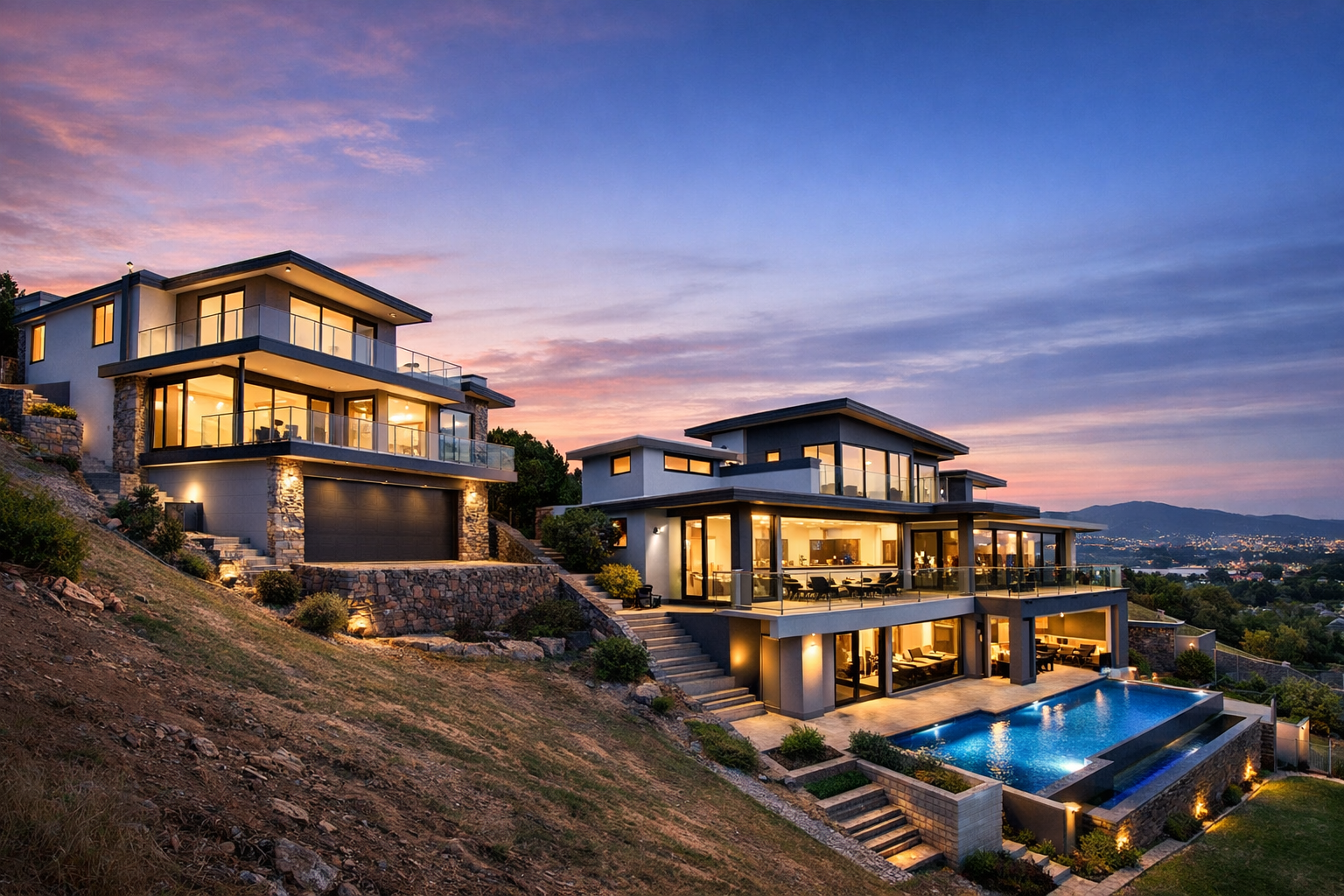
The secret to the great design of sloping block homes is to work with the natural slopes and not against them. The method reduces the cost of excavation, the number of environmental impacts, and gives the buildings distinctive architectural designs that flat blocks could not achieve. Split-level houses, decks, and basement garages are now natural extensions of the topography of your house.
Sloping Up vs Sloping Down: What's the Difference?
Understanding whether your block slopes up or down from the street determines your design options and construction strategy.
Sloping Up Blocks
An up block is slanting upwards and away from the level of the street towards the back of the house. These blocks can have a lot of upper-level views and inherently make basement or lower-level garages. The front of your house is at the street level, and further stories are erected on the rising land behind the house.
Sloping up blocks has the design benefits of providing more privacy to the rear living spaces, natural light on various fronts, and spectacular views of areas up high in elevated rooms. These blocks, however, require planning for driveway access and may necessitate retaining walls to help control the slope.
Sloping Down Blocks
A sloping block runs away on the street to the rear of the property. These blocks normally permit a great presence on the street, with the entire facade of the home being visible on the street. The decreasing levels become a natural part of the descending landscape, forming smooth transitions between indoor and outdoor residential areas.
Down slope designs are good when used to create dramatic entertainment places, excellent natural drainage, and privacy is attained compared to neighboring properties. The habitable spaces are usually at street level, where other rooms are located at the slope underneath.
Our Whitlam Project: Conquering a 4-Meter Sloping Up Block
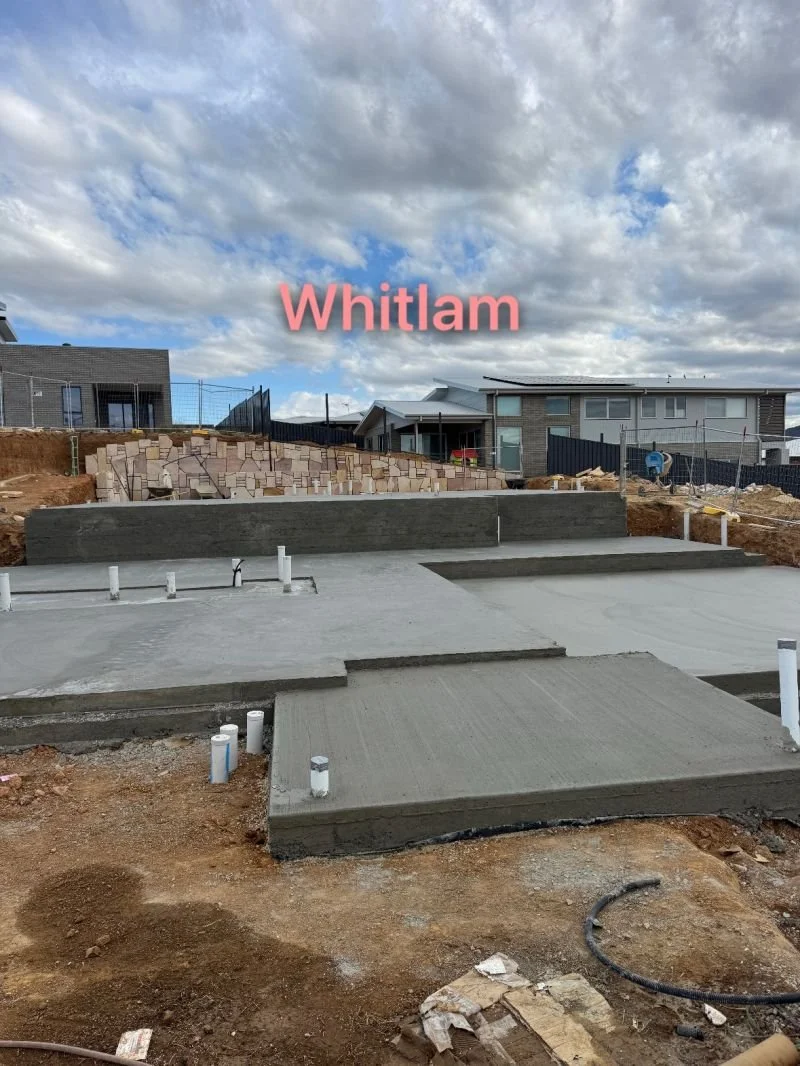
Our most recent project at Virk Construction Management was completed in Whitlam, and it was an uphill project that best illustrates our competence in dealing with the requirements of sloping block builders. The location had a steep 4-meter ascending slope towards the street, which posed difficulties and opportunities.
The Whitlam property needed to be dug deep and have the exact base work done to provide stable building levels at various levels. We poured concrete in massive slabs at varying heights, as seen in the construction photos, critically planning the level so that it fit with the rising terrain. The white PVC pipes that stick out of the concrete suggest strategic positioning of the plumbing and drainage systems that are specially made to suit the sloped areas.
The retaining wall system we installed, using well-stacked bricks that can be seen in the background, is a sophisticated one that will control soil pressure and provide us with open areas of use. The concrete work features other levels of platforms, which will later be used to support various living spaces, making the maximum use of the 4-meter height difference. This design would also turn the steep slope into a multi-tiered house that had separate areas of living, entertainment, and a space of retreat.
The dramatic sky in the construction photo alludes to the weather factor that sloping block builders need to be aware of during the construction. The correct drainage is vital on the steep sites, and in our Whitlam project, there are extensive stormwater management systems that are seen in the exposed drainage pipes.
Key Design Considerations for Sloping Blocks
Foundation and Structural Requirements
Sloping block home designs demand specialized foundation systems that accommodate uneven terrain while ensuring structural integrity. Stepped footings, pier and beam systems, or split-level slabs distribute building loads appropriately across varying elevations. These foundations cost more than standard slabs but provide essential stability for homes on slopes.
Professional engineers must calculate soil pressure, potential movement, and water flow to design foundations that last for generations. The steeper your slope, the more critical these engineering considerations become for your home's long-term stability and safety.
Retaining Walls and Terracing
Most sloping blocks require retaining walls to create level outdoor areas and prevent soil erosion. These structures serve both functional and aesthetic purposes, defining garden beds, creating terraced lawns, and adding architectural interest to your landscape. Quality retaining walls represent a significant investment but prove essential for successful sloping block designs.
Terracing transforms steep slopes into a series of usable outdoor spaces, each with its own character and purpose. Consider multiple terrace levels for gardens, entertaining areas, and children's play spaces that flow naturally down your property's contour.
Access and Driveway Design
Driveway placement and garage access require careful planning on sloped blocks to ensure safe, practical vehicle access. Steep driveways may need special surfacing for traction, while gentle curves can reduce the effective gradient. Some sloping block designs incorporate basement or lower-level garages that nestle naturally into the slope.
Local council regulations often specify maximum driveway gradients and minimum turning circles, which may influence your home's overall design. Experienced sloping block builders navigate these requirements seamlessly while creating functional, attractive access solutions.
Maximizing Benefits of Sloping Block House Designs
Capturing Views and Natural Light
Elevated building positions on sloping blocks provide exceptional opportunities for capturing views and maximizing natural light. Strategic window placement and room orientation allow you to showcase panoramic vistas while maintaining privacy from neighboring properties. Upper-level living areas benefit from abundant sunlight and cross-ventilation that improves energy efficiency.
Consider floor-to-ceiling windows on elevated levels, strategically placed skylights, and clever internal design that draws natural light deep into your home. These features reduce artificial lighting needs and create bright, healthy living environments.
Creating Distinct Living Zones
The multi-level nature of sloping block home designs naturally separates living areas into distinct zones. Parents' retreats occupy upper levels while children's bedrooms sit below, or living areas flow across middle levels with private spaces above and below. This vertical separation provides natural noise buffering and privacy that single-level homes cannot match.
Split-level designs create architectural interest while defining spaces for different activities without requiring walls or doors. Open-plan living gains an additional dimension when spaces flow across multiple levels connected by feature staircases.
Outdoor Living Integration
Sloping blocks excel at integrating indoor and outdoor living through elevated decks, covered patios, and terraced gardens. Each level can open onto outdoor spaces with different aspects, sun exposure, and privacy levels. Morning coffee spots, evening entertainment areas, and private garden retreats become natural extensions of your home's design.
Undercover areas beneath elevated sections provide additional outdoor storage, workshops, or all-weather entertaining spaces. These bonus areas add significant value and functionality to your property without increasing the building footprint.
Choosing the Right Sloping Block Builders
Successful sloping block construction requires specialized knowledge, experience, and attention to detail that general builders may lack. Look for builders who demonstrate proven expertise with sloped sites, understand local soil conditions, and maintain relationships with qualified engineers and surveyors.
Request examples of completed sloping block projects similar to your site's gradient and design aspirations. Quality builders provide detailed quotations that clearly outline foundation work, retaining walls, drainage systems, and all slope-specific costs. Transparency about challenges and realistic timelines indicates a builder's genuine expertise and integrity.
Why Choose Virk Construction Management
At Virk Construction Management, we specialize in transforming challenging sloping blocks into exceptional homes throughout the region. Our recent Whitlam project, with its impressive 4-meter upward slope, demonstrates our capability to handle even the most demanding sites. We combine engineering precision with architectural vision to create homes that exceed our clients' expectations.
Our comprehensive approach includes detailed site analysis, innovative design solutions, and meticulous construction management from initial excavation through final handover. We coordinate all specialized trades, ensure compliance with council requirements, and maintain clear communication throughout your building journey. When you choose Virk Construction Management for your sloping block home, you gain a partner committed to excellence and your complete satisfaction.
Conclusion
Sloping block house designs offer unique opportunities to create distinctive, architecturally impressive homes that stand out from conventional flat-block construction. Whether your land slopes up or down, experienced sloping block builders in ACT can transform the gradient into a defining feature of your home. The key lies in understanding your block's specific characteristics and working with professionals who possess the expertise to maximize its potential.
Building on a slope requires additional investment in foundations, retaining walls, and drainage systems, but the resulting home offers advantages that justify these costs. Enhanced views, natural light, distinct living zones, and exceptional indoor-outdoor integration create living environments that flat blocks simply cannot replicate. With careful planning and skilled construction, your sloping block becomes the foundation for your dream home.