
What Are the Five Structural Problems of Concrete?

Published by Adeel Virk
Adeel is a founder & project manager at Virk Construction Management, delivering ethical, high-quality residential and commercial projects in NSW and Canberra.
Concrete looks permanent. It sits there, grey and solid, and most people assume it will hold its shape forever. In reality, concrete is a material that reacts constantly to moisture, temperature, load, and the quality of the mix that went into it on the day it was poured. When something goes wrong during batching, curing, or design, the problem often does not show up for months or years. By the time it does, the fix is far more expensive than it would have been at the pour stage.
For anyone managing a build in Canberra, understanding these failure patterns is not just a technical exercise. Canberra experiences sharp temperature swings between summer and winter, along with reactive clay soils in several suburbs, both of which put extra stress on concrete elements. This guide walks through the five most common structural problems of concrete, why they happen, and what they mean for a project.
Why Does Concrete Fail Even When It Looks Fine?
Concrete is a composite material made of cement, aggregate, water, and often steel reinforcement. Each component has to work in balance. Too much water weakens the final strength. Poor compaction leaves gaps inside the pour. Reinforcement placed too close to the surface invites corrosion years down the line. None of these issues are visible on the surface at handover, which is exactly why so many building defects surface long after construction management Canberra teams have moved on to the next project.
The Five Structural Problems of Concrete Explained
1. Cracking
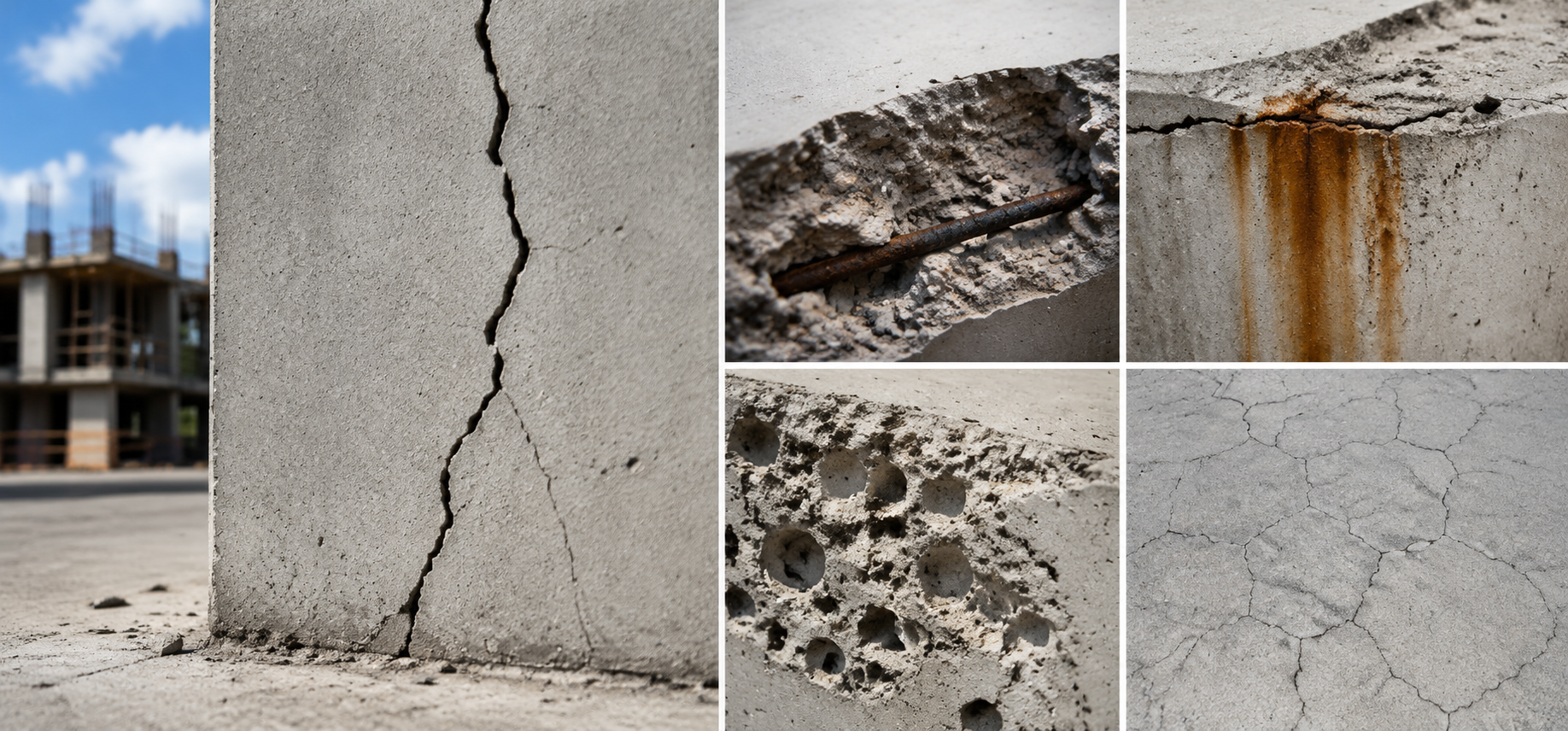
Cracking is the most common and most misunderstood concrete problem. Not every crack signals structural failure, but ignoring the wrong type of crack can lead to serious issues.
Shrinkage cracks appear as concrete cures and loses moisture, usually within the first month.
Thermal cracks form when temperature differences between the surface and the core create internal stress.
Structural cracks develop under load, foundation movement, or design error, and these are the ones that demand immediate attention from an engineer.
A hairline crack under 0.3 millimetres is generally cosmetic. Anything wider, especially if it runs diagonally across a wall or spans a slab edge, points to movement that needs investigation.
2. Spalling
Spalling happens when chunks of the concrete surface break away, exposing the aggregate or reinforcement underneath. It is common on driveways, balconies, and exposed slabs.
The main triggers include:
Freeze and thaw cycles that force trapped water to expand inside the pores
Corroding reinforcement pushing outward against the surrounding concrete
Poor quality aggregate that reacts badly to weather exposure
Excess surface finishing that weakens the top layer during construction
Spalling rarely stays cosmetic. Once it starts, it accelerates, because the exposed surface absorbs even more moisture.
3. Reinforcement Corrosion
Steel reinforcement gives concrete its tensile strength, but steel rusts when exposed to oxygen and moisture. As rust forms, it expands to roughly seven times the original volume of the steel, which cracks the surrounding concrete from the inside out.
Common causes include:
Reinforcement placed with insufficient concrete cover
Chloride exposure from coastal air or de-icing salts
Carbonation, where atmospheric carbon dioxide lowers the concrete's natural alkalinity over time
This is one of the more dangerous structural problems of concrete because the damage is invisible until cracking or rust staining appears on the surface, at which point the steel underneath may already be significantly compromised.
4. Honeycombing
Honeycombing refers to visible voids or gaps in the concrete surface, usually caused during the pour itself. The name comes from the cavity pattern it leaves behind, resembling a honeycomb.
It typically results from:
Poor vibration or compaction during placement
Formwork that is not sealed properly, allowing the mix to leak
A concrete mix that is too stiff to flow around reinforcement and into corners
Reinforcement placed too densely for the aggregate size being used
Honeycombing weakens the load-bearing capacity of the affected section and creates an entry point for water and air, which speeds up corrosion in nearby reinforcement.
5. Alkali Silica Reaction
Alkali silica reaction, often shortened to ASR, is a slower and less obvious problem. It occurs when certain reactive minerals in the aggregate react chemically with the alkalis in cement, forming a gel that expands when it absorbs moisture.
Signs of ASR include:
Map-style cracking spread across a large surface area
Gel deposits visible at crack edges
Gradual expansion that distorts slabs, columns, or pavement over years
ASR is difficult to reverse once it starts, which makes aggregate testing at the mix design stage the most effective defence.
Comparing the Five Structural Problems of Concrete
| Problem | Primary Cause | Typical Warning Sign | Risk Level | Common Repair Approach |
|---|---|---|---|---|
| Cracking | Shrinkage, thermal stress, load movement | Visible surface lines | Low to high, depending on width | Sealant, epoxy injection, or structural repair |
| Spalling | Freeze thaw cycles, poor finishing | Surface flaking or chipping | Moderate | Surface patching, protective coating |
| Reinforcement Corrosion | Insufficient cover, chloride exposure | Rust staining, cracking along steel lines | High | Concrete removal, steel treatment, re-pour |
| Honeycombing | Poor compaction or vibration | Visible voids or pitted surface | Moderate to high | Grout injection, patch repair |
| Alkali Silica Reaction | Reactive aggregate and alkali cement | Map cracking, gel at cracks | High, long term | Monitoring, moisture control, in severe cases replacement |
Frequency of Structural Concrete Defects on Australian Sites
Industry defect reports across residential and commercial builds consistently point to cracking and reinforcement corrosion as the two most reported issues. A simplified breakdown, based on general trends observed in building defect studies, looks like this.
Common Concrete Problems by Share
Cracking sits at the top simply because it is the easiest defect to spot, though it is not always the most costly to fix. Reinforcement corrosion, while less frequent, tends to carry the highest repair cost because it often requires opening up finished concrete to reach the steel.
How Do These Problems Affect Canberra Construction Projects?
Canberra's climate and soil profile create specific pressure points for concrete. Winters bring frost in low-lying suburbs such as Gungahlin and parts of Belconnen, which increases the risk of freeze-related spalling on exposed slabs and driveways. Summers push surface temperatures high enough to cause rapid shrinkage cracking if curing is rushed.
The type of project also changes the risk profile. A residential slab has different exposure conditions to a commercial build. When we handle Office fitouts, floor slabs need to remain level and crack-free under sustained foot traffic and fitted furniture loads, which means compaction quality during the original pour matters more than most people realise.
Retail and hospitality spaces bring their own considerations. A commercial fitout often involves cutting into existing slabs for new services, which can expose reinforcement that was previously protected and accelerate corrosion if it is not resealed correctly. The same applies to a retail fitout where floor finishes are replaced, and the substrate condition only becomes clear once old flooring is removed.
Hospitality venues face tighter scrutiny again, since health compliance depends on sound flooring and wall structures. A restaurant & Cafe Fitout has to pass inspection before trading begins, so any concrete defect discovered mid-project can delay an opening date and cost real revenue.
Preventing Structural Concrete Problems During Construction
Most of these defects are preventable with the correct process at the pour stage. A few practices consistently reduce risk.
Test aggregate for reactivity before it goes into the mix, particularly on larger commercial pours.
Maintain correct water-to-cement ratio rather than adding water on site for easier finishing.
Ensure adequate concrete cover over reinforcement, following AS 3600 requirements for the exposure classification.
Cure concrete properly for the full recommended period, especially during Canberra's hot dry summer months.
Use qualified trades for vibration and compaction, since rushed placement is the leading cause of honeycombing.
Schedule regular inspections during the pour, not only after it has cured
When to Call a Professional?
Some cracks and surface issues are genuinely cosmetic and do not need urgent attention. But wider cracks, rust staining, spalling near reinforcement, or any sign of movement in a slab or wall should be assessed by a structural engineer or an experienced builder. Waiting rarely makes these problems smaller.
If you are planning a build or renovation and want the concrete work done right from the first pour, working with one of the best builders Canberra has to offer makes a measurable difference to long-term durability. Proper mix design, correct cover, and disciplined curing practice cost very little compared to structural repairs down the line.
Get It Right From the Start
Virk Construction Management has delivered residential and commercial projects across Canberra and the ACT for years, with structural concrete quality built into every stage of the process rather than treated as an afterthought. If you are planning a new build, a knockdown rebuild, or a commercial fitout and want a team that understands local soil conditions and compliance requirements, get in touch with Virk Construction Management for a consultation. You can also browse more building and construction guides on our blog for further reading on structural quality and project planning across Canberra and NSW.