
What is the Most Common Tool Used in Construction?

Published by Adeel Virk
Adeel is a founder & project manager at Virk Construction Management, delivering ethical, high-quality residential and commercial projects in NSW and Canberra.
Walk onto any construction site, anywhere in the world, and you will see dozens of tools scattered around. Power saws, levels, drills, scaffolding, you name it. But if you asked every worker there to reach into their belt or bag and pull out the one thing they grab almost without thinking, you would see the same answer come up again and again.
The hammer. And yeah, that probably sounds obvious. But there is a reason it has been around for thousands of years and shows zero signs of going away. The hammer is not just a tool. It is basically the foundation of how we build things. Everything else kind of came after it.
But here is where it gets interesting. Construction is not just about one tool. The hammer might be the most iconic, but it does not work alone. There is a whole ecosystem of everyday tools that crews rely on constantly, and understanding why they matter can actually change how you think about construction as a whole. Let's get into it.
Why the Hammer Is Still King
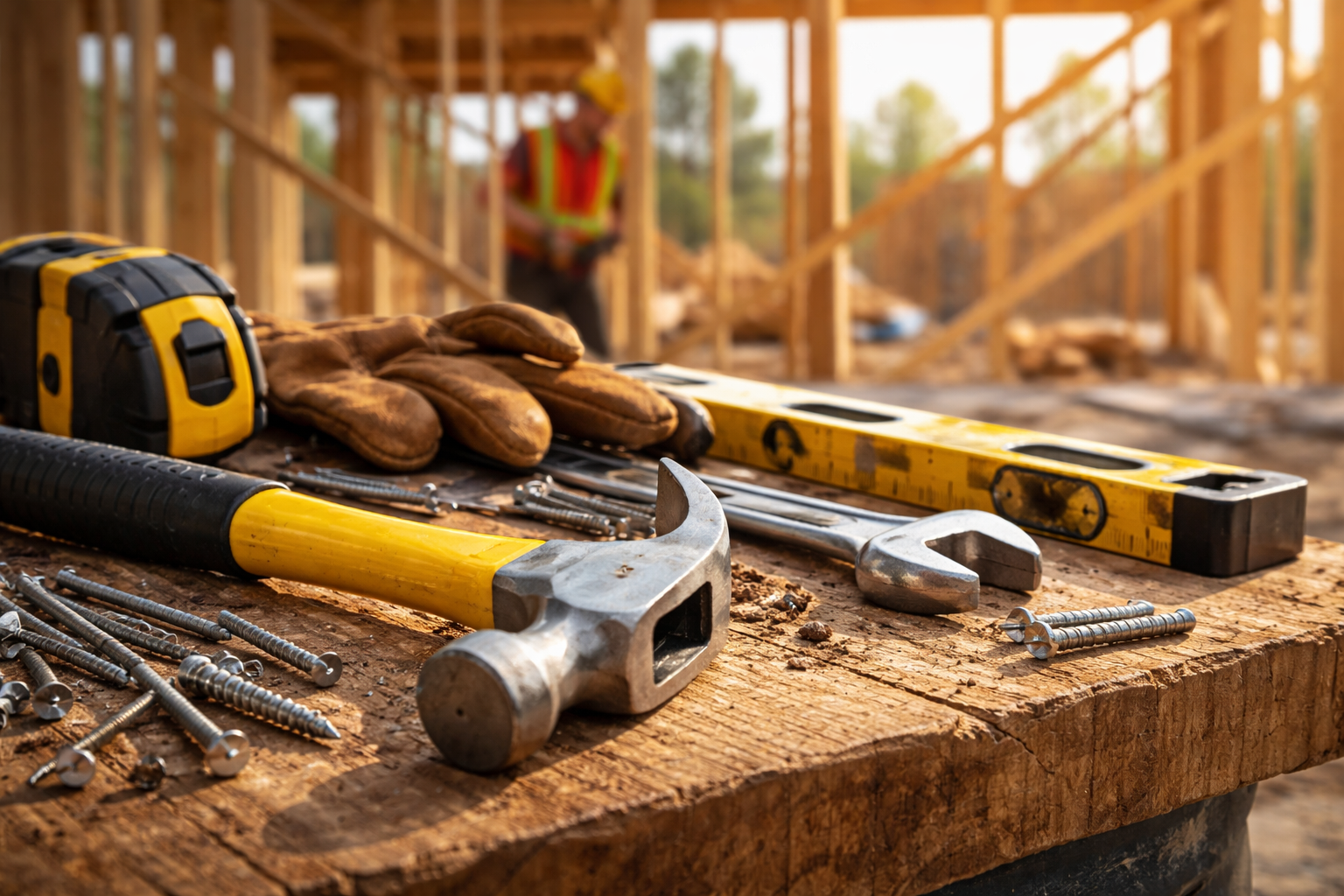
The claw hammer, specifically, is the one most people picture. It has a flat striking face on one end and a forked claw on the other for pulling nails out. Simple design. Incredibly effective. And it has barely changed in centuries because it does not need to.
Here is what makes it the most common tool on any site:
It requires zero power source
It works in any weather condition
It is lightweight and easy to carry
It can be used for driving, pulling, and sometimes even prying
Almost every trade on a job site uses it at some point
Framing carpenters use it constantly. Roofers use it. Drywall crews use it. Even electricians and plumbers grab one when something needs to be knocked into place or a stubborn nail needs to come out. It crosses trades in a way almost nothing else does.
There are also different hammer types depending on the job, which is worth knowing if you are new to the construction world.
Types of Hammers Commonly Used in Construction
Claw Hammer: The standard. Goes in almost every tool belt on the planet.
Framing Hammer: Heavier than a regular claw hammer. Designed specifically for driving large nails into framing lumber fast. If you are building walls, this is what you reach for.
Sledgehammer: When you need to knock something down, break through concrete, or drive stakes into the ground, this is the one. No finesse required.
Rubber Mallet: Used when you need force without damage. Tile work, cabinetry, anything where a metal face would cause problems.
Roofing Hammer: Has a built-in gauge for spacing shingles and a hatchet-like blade on the back. Specific but incredibly useful for what it does.
Each of these fills a different role, but the claw hammer is the one that almost every person on site keeps with them at all times.
The Other Tools That Show Up Everywhere
Okay, so the hammer takes the top spot, but construction is teamwork. The tools around it matter just as much. These are the ones you will see used constantly across nearly every type of project.
1. The Tape Measure
If the hammer is the most grabbed tool, the tape measure is the most reached for. Measuring happens constantly on a job site. Constantly. Before cuts, after cuts, checking alignment, verifying dimensions from a blueprint, you measure things dozens of times a day.
A good tape measure is:
At least 25 feet long for most residential work
Magnetic tipped for working alone with metal
Wide enough that the blade stays rigid when extended
Clearly marked with both imperial and metric
Most experienced workers carry their tape on their belt right next to their hammer. Losing your tape is basically losing your ability to do anything useful for the next hour until you find another one.
2. The Level
A tape measure tells you how long something is. A level tells you if it is actually straight. And in construction, straight matters more than most people realize.
A wall that is slightly off level might not look wrong at first. But then you go to install cabinets, and nothing lines up. Or you lay flooring, and it looks subtly wrong in every photo forever. Levels prevent all of that.
Bubble levels are still widely used and totally reliable
Laser levels have become popular for longer spans and layout work
Torpedo levels (the small ones) fit in a tool belt and get used constantly for quick checks
3. The Speed Square
This one does not always get the credit it deserves. A speed square is a triangular tool that helps you mark angles and guide your saw when making cuts. For anyone doing framing, it is basically an extension of their hand.
It is used for:
Marking 90-degree and 45-degree cuts quickly
Checking corners for a square
Guiding a circular saw for straight cuts
Laying out rafter angles
Small, cheap, and incredibly useful. Most farmers own three of them because they get left places constantly.
4. The Utility Knife
A sharp blade cuts through drywall, insulation, roofing felt, sheathing tape, packaging, flooring material, and about a hundred other things. Utility knives are everywhere on job sites because cutting things is just part of the day.
The retractable kind with replaceable blades is the standard. Blades get dull fast, especially when cutting rough materials, so having a few extras in your pouch is just good practice.
5. The Drill and Screw Gun
Power tools deserve a mention here because even though they are not hand tools, they are used constantly. Cordless drills and impact drivers have basically replaced a huge amount of hammer work when it comes to fastening things.
Screws are stronger than nails in many applications, and driving them with a battery-powered tool is much faster than swinging a hammer. Framing still relies heavily on nails (and nail guns), but finish work, cabinetry, decking, and a ton of other tasks run on screws.
Most workers carry:
A cordless drill for drilling holes and driving screws with finesse
An impact driver for high torque fastening without stripping heads
Extra batteries so work does not stop mid-task
What Makes a Tool "Common" on a Construction Site
When people ask what the most common tool in construction is, they usually mean one of two things. They either want to know what tool shows up the most across different trades, or they want to know what tool gets used the most times in a single day.
By the first measure, the hammer wins. Every trade has one.
By the second measure, it might actually be the tape measure. Measuring is a continuous activity. You measure before, during, and after almost every task.
But honestly, asking which tool is most common is kind of like asking which ingredient is most important in cooking. The answer depends on what you are making. A framing crew would tell you their nail gun is the most important thing on site. A tile setter would say their trowel. An electrician might say their wire strippers.
The common thread is that every crew, on every site, regardless of trade, has a short list of tools that they absolutely cannot work without. And that list almost always includes a hammer, a tape measure, a level, and something to cut with.
Why Quality Tools Actually Matter
There is a difference between buying a cheap hammer from a discount store and buying one that is built for daily professional use. The balance is different. The grip is different. The durability is different. A tool that workers use for eight or more hours a day needs to hold up, or it becomes a liability instead of an asset.
The same goes for all of it. A tape measure with a flimsy blade that buckles under its own weight after two feet is useless on a large layout. A level with a cracked vial is worse than no level at all because it gives you false confidence.
Good tools:
Last longer and reduce replacement costs
Reduce fatigue because they are balanced properly
Perform more accurately
It's safer to use
For anyone managing a crew or running a project, investing in quality tools is not optional. It is just part of doing the work right.
Wrapping it up
The most common tool in construction is the hammer. That answer has been true for a very long time, and there is no sign of that changing. But the hammer does not work in isolation. It is part of a broader set of tools that workers depend on every single day to measure, cut, fasten, and check their work.
Understanding what those tools are and why they matter gives you a much clearer picture of what construction actually looks like from the ground up.
If you are looking for construction management that actually understands the work being done at every level, Virk Construction Management brings that kind of hands-on knowledge to every project they take on. They know the tools, the trades, and what it takes to get a job done right.