
Asbestos Removal and Knockdown Rebuild Canberra: A Technical Guide for ACT Owners

Published by Adeel Virk
Adeel is a founder & project manager at Virk Construction Management, delivering ethical, high-quality residential and commercial projects in NSW and Canberra.
Most owners begin a knockdown rebuild by looking at floor plans. That is natural. Floor plans are the fun part. But on an older Canberra block, the first real decision is asbestos, and it shapes almost everything that follows.
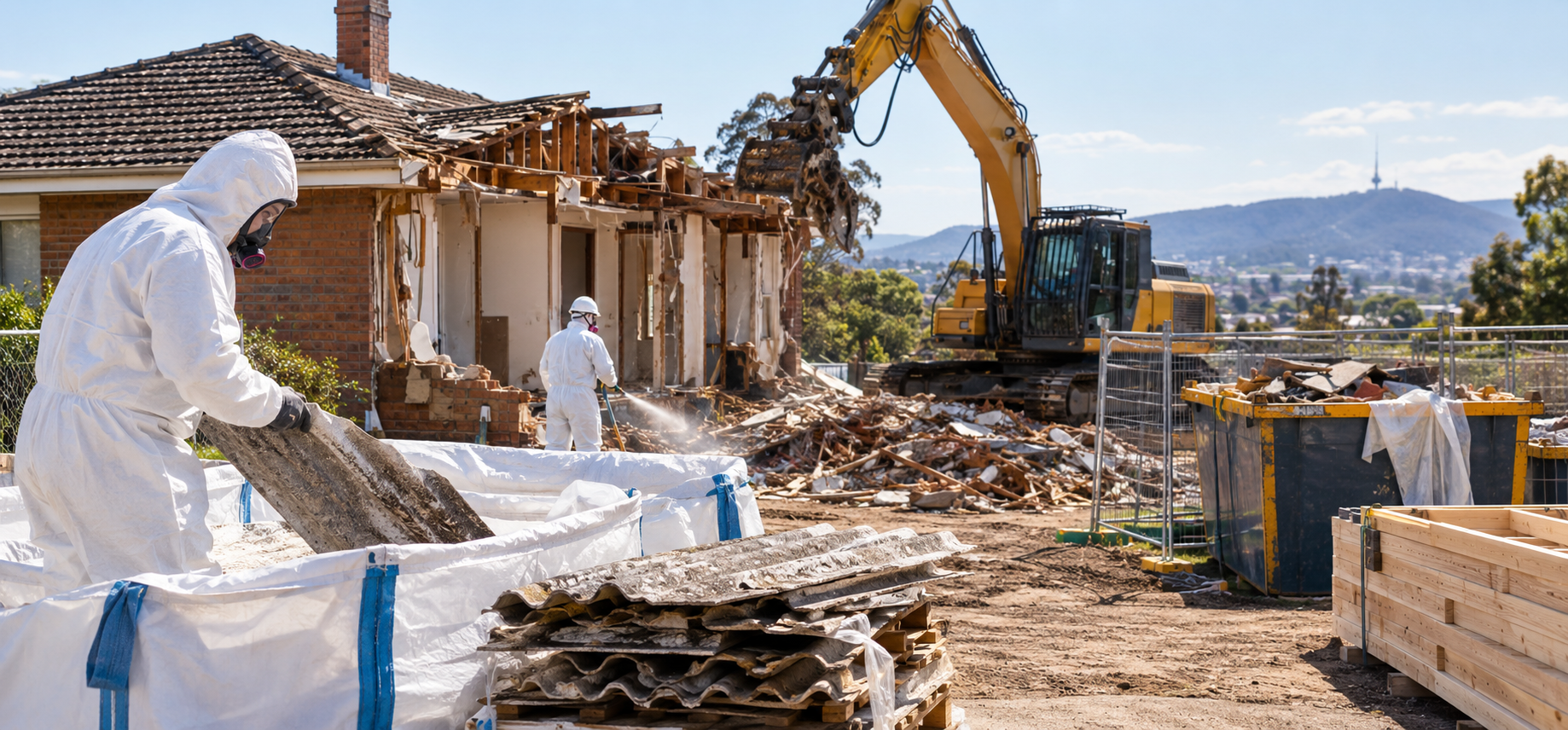
This guide covers asbestos removal and knockdown rebuild Canberra projects from a technical angle. You will see how ACT rules work, how the demolition process is sequenced, and where projects lose time. I also want to offer a view that most guides skip. Asbestos is not only a safety task. It is a scheduling problem and a ground problem. Treat it that way, and you protect both your budget and your calendar.
Why Older Canberra Homes Need an Asbestos Check First
Australia banned asbestos at the end of 2003, so any home built before then may contain it. The risk is highest in houses built before the mid 1980s. Access Canberra asks for asbestos advice in sales and tenancies for homes built before 1985.
Asbestos is commonly found in these places:
Fibro wall sheeting, eaves and garage linings
Cement roof sheeting, gutters and flue pipes
Vinyl floor tiles and the adhesive beneath them
Bathroom and laundry wall linings
Old meter boards and backing sheets
You cannot identify it by eye. A licensed assessor takes samples and issues a report. That report becomes the base document for the whole project.
The Mr Fluffy Chapter
Canberra has a history that no other capital shares. Loose fill asbestos insulation, known as Mr Fluffy, was blown into roof spaces between 1968 and 1979. The ACT Government published a list of 1,022 affected properties in 2015 and ran a buyback and demolition program.
Affected properties are managed under the Dangerous Substances Act 2004. Private owners of remaining properties face restrictions on development and building approvals. ACT Planning also excludes buildings containing loose-fill asbestos from its standard demolition exemption. Check the register before you commit to any purchase or design.
Bonded and Friable Asbestos: The Technical Difference
Bonded asbestos holds its fibres inside a solid product such as cement sheet. It releases fibres mainly when broken, drilled, sanded or badly weathered. Friable asbestos is different. It can crumble under hand pressure, so fibres escape easily. Loose fill insulation is friable.
This split matters for demolition. Bonded sheeting is usually removed piece by piece with wet methods and careful wrapping. Friable material needs tighter containment, and the ACT Government's own Mr Fluffy work uses negative air conditions inside affected houses. The higher the release risk, the stricter the controls.
The licence system follows the same logic:
Class A licence: covers all asbestos, including friable material
Class B licence: covers bonded asbestos only
Licensed assessor: handles identification, risk assessment, air monitoring and clearance inspections in the ACT
Part 8.10 of the Work Health and Safety Regulation 2011 sets the competency rules. Interstate licence holders must also notify WorkSafe ACT before working in the territory. Every licence can be checked on the WorkSafe ACT public register. Use it. It takes two minutes.
The Demolition Process in Canberra, Stage by Stage
A knockdown rebuild follows a fixed order. Asbestos work comes first, structural demolition second, and new construction last. The table shows who leads each stage and which paperwork matters.
| Stage | Who Leads | Key Paperwork | Watch Point |
|---|---|---|---|
| 1. Survey | Licensed assessor | Asbestos report and hazardous materials survey | Include roof space and sub floor |
| 2. Approvals | Owner, builder, certifier | Development approval or exemption, building approval, demolition licence | Neighbour notice may apply |
| 3. Notice | Licensed removalist | Notice of Asbestos Removal Work | At least five days before removal |
| 4. Removal | Class A or Class B removalist | Safe work method statement | Match licence class to material |
| 5. Clearance | Licensed assessor | Asbestos clearance certificate | No demolition until issued |
| 6. Demolition | Licensed demolisher | Work plan under AS 2601 | Dust, noise, services disconnection |
| 7. Disposal | Removalist and demolisher | REMONDIS disposal form | Form due two days before delivery |
| 8. Ground check | Licensed assessor | Soil inspection report | My recommendation, see below |
Two details deserve attention. Under section 466 of the WHS Regulation, the removalist must give WorkSafe ACT written notice at least five days before licensed removal starts. Second, the WorkSafe ACT demolition notification checklist asks for a demolition permit, a demolition licence, a hazardous material survey, a high-risk work method statement, a risk assessment, and an AS 2601 work plan. One missing document delays approval, and that delay lands on your calendar.
A Different Angle: Asbestos Controls Your Schedule
Most guides treat asbestos as a line item. In practice, it behaves like a critical path. Two features make this clear.
The Disposal Window Is a Hidden Bottleneck
Commercial asbestos loads in the ACT go to the Mugga Lane Resource Management Centre, and only by appointment. The operator, REMONDIS, needs a disposal form two days before delivery. The asbestos yard opens from 7.30 am to 12.30 pm on weekdays only.
Now picture an ordinary week. Removal finishes late on a Thursday. The wrapped material is ready, but the yard closes at 12.30 pm. If the Friday booking slips, the next chance is Monday. Nothing illegal happened. It simply cost three days, and a site with a hired excavator on standby pays for each one.
Mugga Lane Weekday Hours
Each block represents 30 minutes
The chart shows the point clearly. Asbestos loads get roughly half of the daily window. Confirm current hours with the operator before you book trucks.
The Ground Is the Last Unknown
A clearance certificate covers the removal area it names. It says nothing about what sits under the lawn or slab. Older blocks sometimes hold buried fibro offcuts from past building work and backyard clean-ups. Nobody sees them until the excavator digs for footings.
That discovery stops work. Soil handling then needs an assessor, a removalist and more disposal bookings. The fix is planning, not luck:
Ask the assessor to inspect exposed ground after demolition and before footings
Add a provisional sum for asbestos in soil to the contract
Schedule excavation with a few spare days after demolition
Photograph and log anything found, with locations
This is the perspective I would push hardest. The building is the visible risk. The ground is the risk that nobody prices.
What Drives the Cost
Every quote differs, so I will not print a single number. Cost follows a few drivers:
Quantity and type: friable material costs more than bonded sheeting
Access: tight blocks and two-storey homes slow the work
Disposal: volume, packaging, booking timing and truck runs
Extras: soil inspection, air monitoring where required, services disconnection
Approvals: certifier fees and neighbour notification work
Ask tenderers to price asbestos removal separately from structural demolition. Then you can compare like with like. A low demolition price that hides asbestos allowances is not low at all.
How to Choose Your Team
A construction management company earns its fee at the handovers. The assessor, removalist, demolisher, certifier and builder each hold one piece. If one piece slips, the others wait.
Use this checklist when you interview contractors:
Confirm each licence on the WorkSafe ACT public register
Match the licence class to the material found
Ask for a copy of the Notice of Asbestos Removal Work, as WorkSafe ACT advises
Prefer an assessor who is independent of the removalist
Request the clearance certificate before demolition begins
Ask how the team handles asbestos found in soil
Independence matters. The ACT's own loose fill program relies on independent licensed assessors to issue clearance certificates before any structural demolition. Private owners can borrow that same discipline.
Can I remove asbestos from my Canberra home myself?
No. ACT City Services states that the law requires homeowners to engage a licensed removalist for asbestos in their house. Self-removal also leaves you without a clearance certificate. Check the licence on the WorkSafe ACT public register and keep every notice and certificate.
Do I need development approval to demolish my house?
Sometimes not. ACT Planning lists exemption criteria for residential zones, including written information for next door neighbours before demolition begins. Buildings with loose-fill asbestos are excluded. Building approval and licensing still apply, so confirm your pathway with your certifier before booking demolition.
How long does the asbestos stage take?
It varies with scope, but some minimums are fixed. The removalist must give WorkSafe ACT five days’ written notice, and commercial disposal needs a form lodged two days ahead. Add assessment, reporting, and the clearance inspection, then allow buffer for weather and booking gaps.
Does a clearance certificate mean the whole block is clear?
No. A clearance certificate confirms removal from the inspected area only. It does not cover soil or hidden spaces. Ask your assessor to inspect exposed ground after demolition and before footings, so buried fragments do not surprise you during excavation.
Final Thoughts
Asbestos removal and demolition are links in one chain, not separate errands. The strongest projects survey early, book disposal early, and inspect the ground before footings. Nothing exotic in that. Just order, paperwork and a little respect for the calendar.
Ready to plan your project? Talk to Virk Construction Management, a Canberra construction management company, about a Knockdown Rebuild Canberra pathway that coordinates assessment, the demolition process, and your new build under one plan.