
Demolition Process Canberra: What to Expect
Demolishing a house or structure in Canberra is not just a matter of hiring an excavator and knocking a wall down. The Australian Capital Territory runs one of the more structured demolition frameworks in the country, partly because of its planning system and partly because of a legacy problem most other states do not have to think about. If you are planning a knockdown rebuild, a partial demolition, or a full site clearance in the ACT, understanding the actual sequence of events will save you weeks of delay and a good amount of money.
This guide walks through what really happens, from the first approval application to the final site handover, and includes a detail that almost no other Canberra demolition article mentions.

Published by Adeel Virk
Adeel is a founder & project manager at Virk Construction Management, delivering ethical, high-quality residential and commercial projects in NSW and Canberra.
Why Canberra Demolitions Follow a Different Path
Most Australian states separate demolition approval from building approval. Canberra does not work quite the same way. In the ACT, demolition of a structural building generally needs both Development Approval and Building Approval before any physical work starts. Depending on your block, a separate demolition approval and notification to WorkSafe ACT may also apply. This layered system exists because the ACT Planning system ties demolition closely to what happens next on the block, particularly for knockdown rebuild projects where zoning, setbacks, and tree protection all come into play.
The Approvals You Need Before Work Starts
Development Approval (DA)
A DA is not always required for demolition alone. It becomes necessary when the planned rebuild affects zoning rules, block coverage, or the surrounding streetscape. Your builder or planning consultant can confirm whether your project triggers this step.
Building Approval (BA)
Almost every demolition of a structural building in the ACT needs a BA. This confirms the work complies with the National Construction Code and relevant building regulations. You cannot get a BA without a DA already in place, so the sequence matters.
Demolition Notification to WorkSafe ACT
Once approvals are granted, WorkSafe ACT typically requires at least five business days of advance notice before demolition work physically begins. This gives inspectors time to flag any safety concerns tied to the site.
Here is a quick reference for the approvals most homeowners will encounter. These timeframes are indicative. Complex sites, incomplete applications, or heritage overlays can extend them considerably.
| Approval Type | When It Applies | Typical Processing Time | Issued By |
|---|---|---|---|
| Development Approval | Rebuild affects zoning, setbacks, or streetscape | Six to eight weeks | ACT Planning |
| Building Approval | Almost all structural demolitions | Four to six weeks | Access Canberra |
| Demolition Notification | All structural demolition work | Minimum five business days notice | WorkSafe ACT |
| Asbestos Clearance | Any home built before 1990 with asbestos present | Varies with assessment findings | Licensed asbestos assessor |
The Site Check Most Guides Skip: The Affected Residential Premises Register
Here is the part of the Canberra demolition process that genuinely sets it apart from every other Australian city, and it rarely gets mentioned. Between 1968 and 1979, more than one thousand Canberra homes were insulated with loose-fill amosite asbestos, sold under the name Mr Fluffy. The ACT Government later ran a buyback and demolition scheme to remove the risk permanently, and most of those properties have now been cleared.
A small number of affected homes remain, and discoveries still happen occasionally, including one in Curtin identified as recently as a few years ago when a tradesperson noticed suspicious material during roof work. Before any demolition planning begins on an older Canberra property, particularly one built between the late 1960s and late 1970s, it is worth checking the Affected Residential Premises Register maintained by the Asbestos Response Taskforce. If a property appears on that list, the standard demolition pathway does not apply. It falls under the Dangerous Substances Act and follows a separate, government-managed removal process.
This step costs nothing and takes minutes, yet it can completely change your project timeline if skipped. Most demolition contractors will not raise it unless you ask directly.
1. Asbestos and Hazardous Materials Assessment
Loose fill asbestos is the extreme case, but it is not the only asbestos concern in Canberra homes. Many properties built before 1990 contain bonded asbestos in fibro sheeting, eaves, older vinyl flooring, and bathroom linings. Before demolition, a licensed assessor inspects the site and produces a hazardous materials report. If asbestos is present, a licensed removalist must extract it under controlled conditions before mechanical demolition begins.
Bonded asbestos removal is generally more straightforward than loose fill removal, since the fibres are contained within another material rather than free-floating. Costs for a standard asbestos assessment typically sit between three hundred and six hundred dollars, while removal costs vary widely depending on the extent of contamination.
2. Utility Disconnection and Site Preparation
Before any equipment touches the structure, services need to be safely isolated. This stage includes:
Disconnecting electricity at the meter or pole, confirmed with the relevant provider
Capping gas lines and obtaining written confirmation from the gas network operator
Isolating water and sewer connections back to the property boundary
Removing or redirecting telecommunications cabling
Potholing to physically locate underground services, since existing records are not always accurate
Skipping this stage is one of the most common causes of on-site incidents during demolition, which is why WorkSafe places such heavy emphasis on it in the Demolition Work Code of Practice.
3. The Physical Demolition Stage
Once approvals, assessments, and disconnections are complete, physical demolition can begin. Canberra demolishers typically use excavators fitted with pulverising or shearing attachments for full structural demolition, alongside smaller equipment for selective strip-outs where only part of a building is removed.
Timeframes vary based on the size and condition of the structure. A single-storey house typically comes down in three to five working days. Two-storey homes take five to ten days, since floor separation and structural bracing slow the process. Add asbestos removal into the mix, and total site clearance can stretch beyond a week and a half once assessment, controlled removal, and clearance certification are all factored in.
Typical Canberra Demolition Timelines by Project Type
Working Days by Project Type
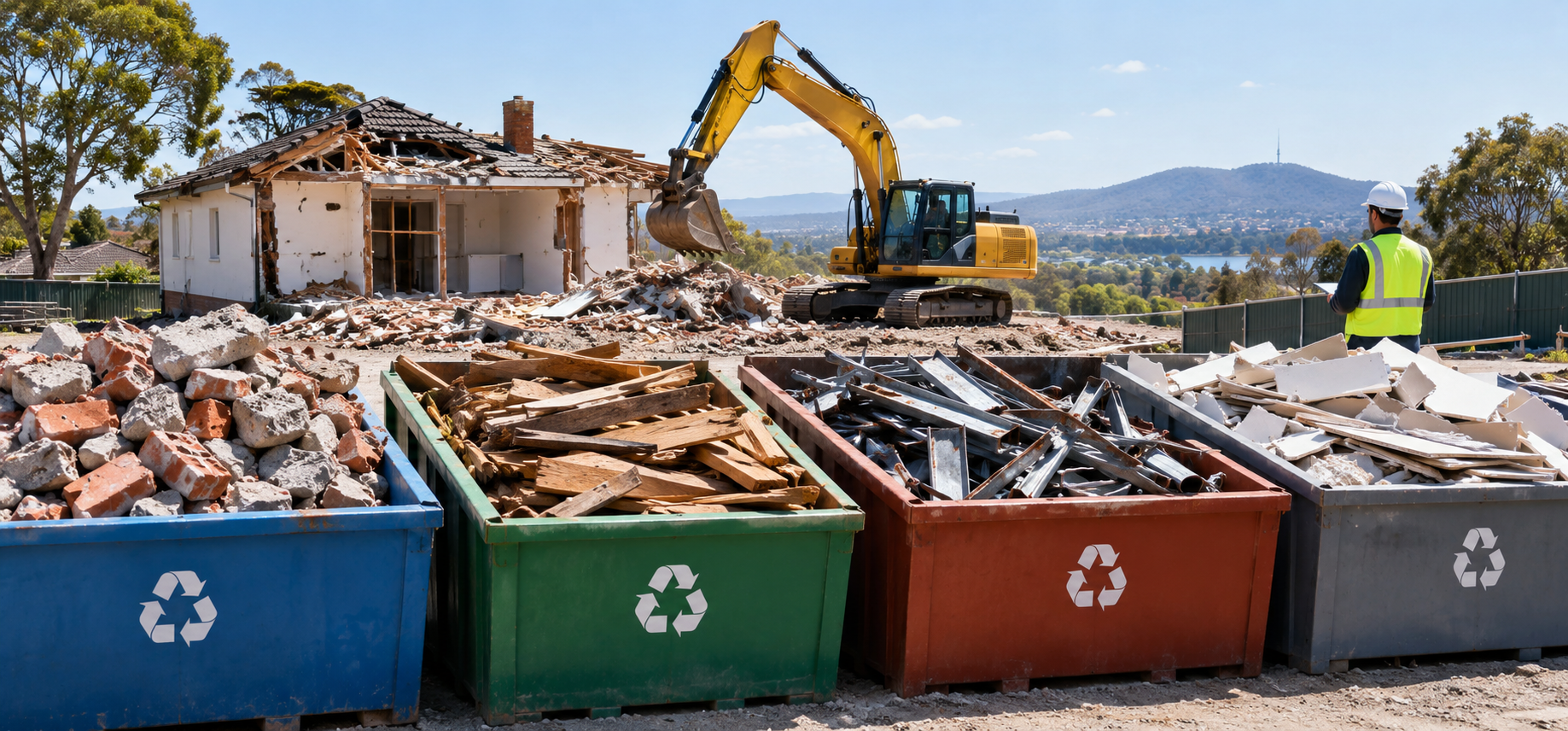
4. Waste Sorting, Recycling, and the ACT Waste Levy
Canberra applies a waste levy on construction and demolition material sent to landfill, pushing most licensed demolishers to recycle wherever possible. On a typical residential demolition, materials get sorted into separate streams:
Concrete and brick, often crushed on site or taken to a recycling facility for reuse as road base
Timber, separated for reuse, mulching, or biomass processing
Metal, including structural steel and roofing, sold to scrap metal recyclers
Plasterboard and general waste, sent to licensed disposal facilities
Sorting on site rather than mixing everything into general waste reduces landfill levy costs and is now standard practice among established Canberra demolition contractors.
5. Site Remediation and Handover
Once the structure is down and waste is cleared, the block needs to be made safe and level. This includes backfilling any excavated areas, compacting the soil, removing footings and slabs where required, and completing a final site inspection. If asbestos is present, an independent assessor must provide a clearance certificate before the site can be signed off. Without this certificate, subsequent building approval for a rebuild will not proceed.
What Determines Cost and Timeline in Canberra
Several factors shape the final cost of a demolition project in the ACT:
Building size and number of storeys
Presence and extent of asbestos or other hazardous materials
Access constraints, particularly on narrow or sloped Canberra blocks
Distance to recycling and disposal facilities
Complexity of the approval pathway, including whether a DA is required
As a general guide, a standard single-storey house demolition in Canberra costs between fifteen and forty-five thousand dollars, with the average sitting close to twenty thousand. Two-storey demolitions typically range from twenty-five to seventy thousand dollars. Asbestos removal, when required, adds a further three and a half to twenty-five thousand dollars or more depending on scope.
Choosing a Licensed Demolisher in the ACT
Demolition work in Canberra can only be carried out by a builder holding the correct demolition endorsement through Access Canberra. This endorsement requires demonstrated experience, references, and evidence of appropriate insurance. Before signing a contract, ask to see the demolisher's licence number and confirm their endorsement covers the scope of your project, particularly if asbestos removal is involved.Planning a Knockdown Rebuild in Canberra
Demolition rarely happens in isolation. Most homeowners going through this process are preparing their block for something new. If you are weighing up a full Knockdown Rebuild Canberra project, working with a team that manages both the demolition approvals and the build that follows removes a significant amount of coordination risk. Virk Construction Management handles the planning, approval, and construction stages together, so nothing falls through the gap between the old structure coming down and the new one going up.
Final Thoughts
The Canberra demolition process is more layered than a straightforward knockdown, mainly because of the approval sequence and the region's asbestos history. Checking the Affected Residential Premises Register early, securing the right approvals in order, and working with a properly endorsed demolisher will keep your project on schedule and free of unwelcome surprises partway through.
Demolition is only the first step. If you are preparing a Canberra block for a knockdown rebuild, Virk Construction Management can manage the entire journey, from demolition approvals and asbestos checks through to design and construction of your new home. Our team understands the ACT planning system, coordinates directly with Access Canberra and WorkSafe ACT, and keeps every stage on schedule so you are not left managing separate contractors or approval gaps. Contact Virk Construction Management today to get a clear, no-obligation plan for your Canberra demolition and rebuild project.