
Fitout Budgeting Tips for Canberra Businesses


Published by Adeel Virk
Adeel is a founder & project manager at Virk Construction Management, delivering ethical, high-quality residential and commercial projects in NSW and Canberra.
A commercial fitout is one of the largest discretionary investments a Canberra business will make outside of rent itself, yet it remains one of the most poorly budgeted. Tenants frequently approach landlords, designers, and builders with a single number in mind, usually drawn from a friend's project or a generic online calculator, without accounting for the specific conditions of the ACT market. The result is a gap between expectation and reality that surfaces midway through construction, when changes are expensive, and timelines are tight.
This guide breaks down what actually drives fitout costs in Canberra, how to structure a budget that survives contact with reality, and where most businesses lose money without realising it.
Why Fitout Budgets in Canberra Often Go Wrong
1. Underestimating Base Building Conditions
Many businesses assume a tenancy is a blank, ready-to-fit slate. In practice, base building conditions vary enormously between Civic towers, Kingston Foreshore developments, and older stock in Braddon or Manuka. A tenancy with exposed services, uneven slab levels, or outdated electrical infrastructure requires remediation before any fitout work begins. This cost is rarely included in early estimates because it only becomes visible after a detailed site inspection.
2. Treating Quotes as Final Numbers
A lump sum quote from a single contractor can look attractive on paper, but it often hides assumptions about scope, finish level, and program duration. Without a trade-by-trade breakdown, businesses have no way to compare quotes accurately or identify where one builder has priced conservatively, and another has cut corners.
3. Ignoring ACT Compliance Costs
Fitouts in the ACT must satisfy specific requirements tied to the National Construction Code, ACT building certification processes, and in some cases NCA approvals for tenancies within designated precincts. Fire safety upgrades, accessibility compliance, and mechanical ventilation standards all carry cost implications that general online guides, written for other states, simply do not capture.
Breaking Down the Real Cost Categories
A realistic Canberra fitout budget separates spend into clear categories rather than a single per square metre figure. The table below outlines typical ranges for a standard commercial office fitout in the ACT, based on current market activity across Civic, Braddon, and Kingston Foreshore tenancies.3
These ranges shift depending on the precinct, the age of the building, and whether the project falls under a Category A or Category B fitout classification. Category A typically refers to base services delivered by the landlord, while Category B covers the tenant-specific finish, which is where most of the budget conversation in this article applies.
A Realistic Fitout Cost Range for Canberra Offices
To put the categories above into context, here is how total spend typically distributes across a mid-sized Canberra office fitout, expressed as a share of the overall budget.
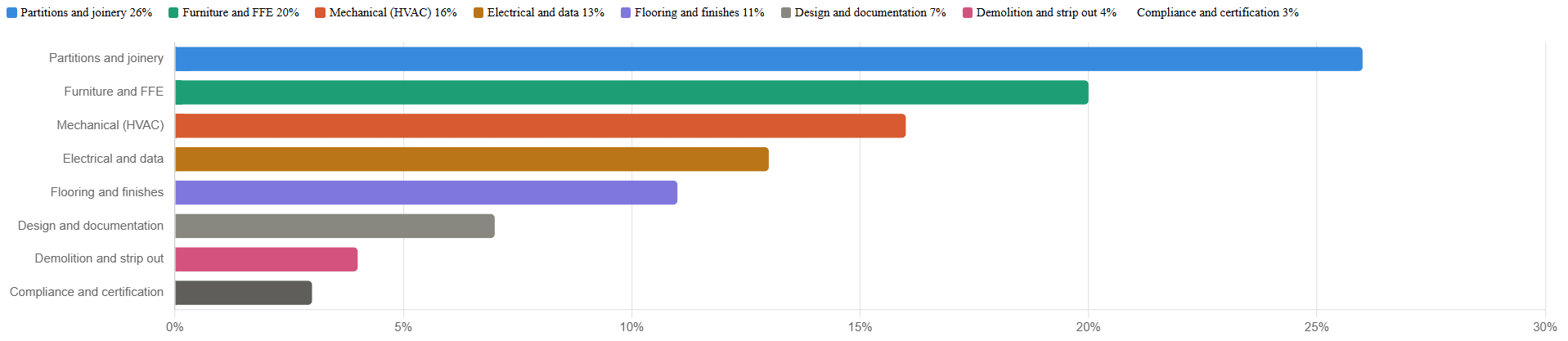
This distribution shifts for hospitality and retail fitouts, where mechanical and joinery costs typically take a larger share due to kitchen exhaust systems and custom shopfronts. Businesses planning a commercial fitout in Canberra should request a category breakdown specific to their industry rather than relying on office benchmarks.
Practical Budgeting Tips for Canberra Businesses
Get a Trade Breakdown, Not a Lump Sum
Ask for pricing broken down by trade before signing any contract. This allows direct comparison between builders and makes variation claims easier to assess later, since each trade has a documented baseline cost. A transparent, open book approach to pricing, where every cost is disclosed rather than bundled into a single figure, gives Canberra businesses far more control over where money is spent.
Build In a Contingency Line
A contingency of 10 to 15 per cent should sit outside the working budget, not inside it. Older Canberra tenancies, particularly those built before 2010, frequently reveal hidden issues once strip-out begins, including asbestos-containing materials in older Civic and Barton buildings that require specialist removal under ACT Health regulations.
Sequence Trades Around ACT Approval Timelines
Building certification and any required NCA sign-off for tenancies within national capital precincts can add weeks to a program if not planned early. Businesses that lock in their fitout design before lodging certification documents often face costly delays, since changes after lodgement can trigger a fresh review cycle.
Match the Fitout Tier to the Lease Term
A five-year lease justifies a different finish level than a two-year lease. Premium joinery and bespoke lighting carry a higher upfront cost that only makes financial sense if the tenancy period allows the business to depreciate that investment properly. Shorter leases benefit from modular partition systems and furniture that can be relocated rather than fixed finishes that cannot be recovered.
How Location Within Canberra Affects Fitout Costs?
Precinct matters more than most businesses expect. Tenancies in Kingston Foreshore and Manuka often carry premium base building specifications, which can reduce the scope of mechanical and electrical upgrades needed during fitout. Civic and Barton properties, many of which house older commercial stock, tend to require more remediation work before the visible fitout even begins. Braddon's mix of converted warehouse spaces and newer developments means costs vary block by block, making an early site assessment essential rather than optional.
Businesses comparing tenancies across these precincts should request a basic condition report before signing a lease, since the cost of bringing an older tenancy up to standard can offset what looks like a cheaper rental rate on paper.
Working with a Transparent Cost Model
The single biggest protection against budget blowouts is contractor transparency. When every trade price, material cost, and variation is documented and justified rather than absorbed into a flat fee, businesses retain the ability to make informed decisions throughout the project rather than discovering cost creep at handover. This approach has helped Canberra businesses identify savings of up to 10 per cent compared to traditional lump sum fitout contracts, simply because nothing is hidden behind a markup. Readers wanting more detail on how this model works in practice can review the Canberra construction FAQs, which cover cost reporting and variation handling in greater depth.
Final Thoughts
Budgeting for a Canberra fitout is less about finding the lowest number and more about understanding where money actually goes and why. A budget built from trade-level detail, realistic contingency, and an awareness of ACT-specific compliance requirements will hold up far better than a single estimate pulled from a generic calculator. Businesses that take the time to separate base building condition from fitout scope, and that insist on transparent trade pricing, consistently end up with fewer surprises and a stronger return on their investment.
For more on how fitout design choices affect both cost and functionality, the fitouts in Canberra overview covers open plan layouts, meeting rooms, and breakout zones in further detail, alongside examples from completed Canberra construction projects.
Get a Clear, Transparent Fitout Budget for Your Canberra Business
Virk Construction Management delivers commercial fitouts across Canberra and the ACT using a fully transparent, open-book cost model, giving businesses complete visibility over every dollar spent. If you are planning an office, retail, or hospitality fitout and want a realistic budget before committing to a lease or design, speak with the Virk Construction Management team about your project today.