

Published by Adeel Virk
Adeel is a founder & project manager at Virk Construction Management, delivering ethical, high-quality residential and commercial projects in NSW and Canberra.
Office fitout costs in Canberra typically range from $400 to $2,500+ per square metre, depending on the fitout category, specification level, and base building condition. A standard Category B fitout for a 200m² office in the ACT generally costs between $140,000 and $220,000, including design, approvals, construction, finishes, and project management.
Planning a commercial office fitout in Canberra is a significant financial decision, and most business owners, property managers, and tenants go into the process without a realistic figure in mind. The market in the ACT is distinct from Sydney or Melbourne. Labour costs differ, the dominant tenancy mix leans heavily toward government agencies and professional services firms, and all commercial construction requires a licensed builder under ACT law. These factors shape what you actually pay.
This guide gives you specific, market-accurate pricing for Canberra office fitouts in 2025, broken down by trade, fitout category, and suburb context.
What is an Office Fitout?
An office fitout is the process of transforming a commercial tenancy, either from a raw base-building shell or an existing occupied space, into a functional, finished workplace. In the commercial property industry, fitouts are classified into three categories:
Base building: The structural shell of the building with no internal fit: raw concrete slab, exposed services, no partitions or ceilings. Tenants bear the full cost of everything.
Category A fitout: The landlord or developer has completed core services infrastructure. This typically includes suspended ceilings, grid lighting, basic HVAC distribution, and amenities (toilets, fire services). The space is habitable but not configured for any specific tenant.
Category B fitout: The tenant-specific buildout on top of a Category A space. This includes internal partitions, meeting rooms, open plan workstations, kitchenettes, flooring, joinery, data and electrical fitout, and branding elements.
Most Canberra tenants signing a new commercial lease negotiate a Category A handover from the landlord and fund Category B themselves, often with a landlord incentive contribution toward the cost.
Looking for a professional office fitout in Canberra? Explore our dedicated office fitout services page to learn more about our process, pricing, and completed projects.
Explore Office Fitout ServicesOffice Fitout Cost Per Square Metre in Canberra (2026)
The following figures reflect current Canberra and ACT market rates. Prices include supply, installation, and standard builder margins but exclude GST, furniture and loose equipment, IT and AV systems, and building approval fees unless otherwise noted.
Real project benchmark: Virk Construction Management completed a spec office fitout in Canberra where a 320m² tenancy was divided into two separate offices of 140m² and 180m². The total cost achieved was $1,350 per square metre for the building owner, covering full Category B scope including partitioning, glazing, electrical, HVAC modifications, commercial joinery, flooring, ceilings, and amenities. This project is documented on the Virk Construction projects page.
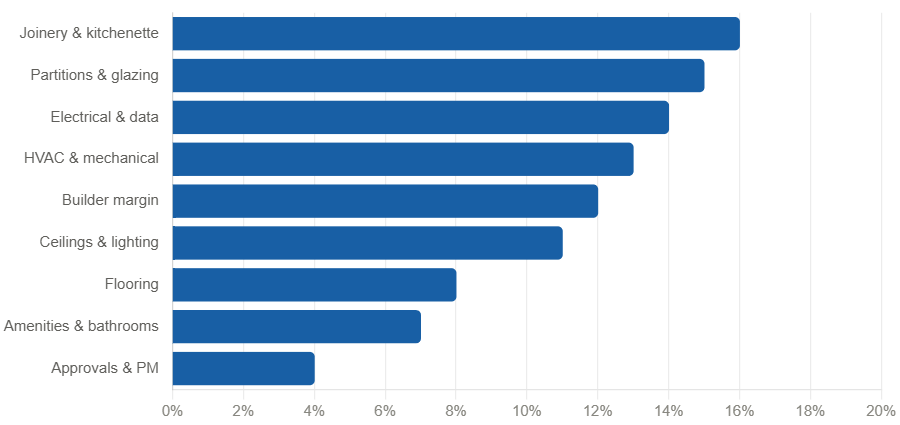
Where Does the Budget Go? Fitout Cost Distribution-
Trade-by-Trade Cost Breakdown for Canberra Office Fitouts
Partitions and Glazing
Standard stud and plasterboard partitions in Canberra cost $180 to $280 per linear metre installed. Acoustic-rated walls, which are standard in meeting rooms for government and legal tenancies, add $50 to $90 per square metre over the base rate. Glazed partitions with commercial aluminium framing sit between $650 and $1,400 per square metre, with frameless glass systems at the upper end. For typical fitouts in Barton, Parkes, or the Canberra City precinct where acoustic separation between meeting rooms is specified, glazing frequently accounts for 18 to 22 percent of the total project budget.
Electrical and Data
A full electrical fitout for a 200m² Canberra office covering power points, data outlets, lighting circuits, and a switchboard modification runs between $25,000 and $45,000. AV infrastructure, structured data cabling to AS/NZS 11801 standard, and server room builds add to this figure. Buildings with pre-2000 electrical infrastructure in older Canberra suburbs may require a full switchboard upgrade, which adds $8,000 to $15,000 depending on the panel condition and load demand.
HVAC and Mechanical
Canberra's climate is one of the most demanding in Australia for HVAC design. The ACT experiences temperatures ranging from minus 5 degrees Celsius in winter to above 38 degrees in summer. Modifying an existing variable air volume (VAV) system to suit a new fitout layout costs $60 to $120 per square metre. Installing a new VRF (variable refrigerant flow) system in a shell tenancy typically starts at $95 per square metre and rises with zone count and building height. Mechanical work is non-negotiable in most Canberra commercial leases and cannot be deferred without occupancy problems.
Joinery and Kitchenette
Commercial joinery is the most variable cost item in most fitout budgets. A standard staff kitchen with laminate carcasses, engineered stone benchtop, sink, and under-bench appliances costs $8,000 to $16,000. A barista-style breakout kitchen with full-height cabinetry, overhead rangehood, and premium fixtures in a mid-range fitout runs $18,000 to $28,000. Reception desks with stone or timber elements, custom storage walls, and bespoke boardroom joinery push the category above $30,000 on a 200m² footprint.
Flooring
Carpet tiles remain the dominant floor finish in Canberra commercial tenancies because they perform well acoustically, are easy to replace in sections, and suit the raised floor systems common in government buildings. Supply and install pricing sits at $45 to $90 per square metre. Luxury vinyl plank (LVP), which has grown in popularity for hybrid workplaces and creative fitouts in the Braddon and NewActon precincts, costs $55 to $100 per square metre installed. Polished concrete grinding and sealing over an existing slab adds $70 to $130 per square metre if the substrate is suitable.
Ceilings and Lighting
Suspended grid ceilings with standard mineral fibre tiles cost $80 to $130 per square metre. Feature ceilings using acoustic baffles, stretched fabric, or plasterboard bulkheads add $150 to $300 per square metre to those zones. LED panel lighting to BCA Section J energy compliance standards is standard on all Canberra commercial fitouts and typically sits within the electrical trade cost rather than as a separate ceiling line item.
ACT-Specific Costs That Most Fitout Guides Miss
Canberra is not just geographically distinct. The ACT has regulatory and procurement requirements that directly affect fitout costs.
ACT Builder's Licence: All commercial fitout work in the ACT requires an A Class or B Class builder's licence. Unlicensed or interstate-only contractors cannot legally complete the work. Always verify your contractor holds an active ACT licence before signing a building contract. Virk Construction Management holds a current ACT licence and is a registered member of the Master Builders ACT.
Building Approval and Certifier Fees: Commercial fitouts in the ACT typically require a development application (DA) and a building approval. DA fees for office fitouts vary by valuation but commonly range from $1,500 to $5,000. Private building certifier fees add $2,500 to $6,000 depending on project complexity.
Secure Local Jobs Code: The ACT Secure Local Jobs Code applies to government tenancy fitouts and some commercial projects above specified thresholds. Contractors must be code-certified, which affects which builders can tender for those projects and can influence both timeline and cost.
Working after hours in CBD buildings: Many Canberra CBD buildings, particularly those managed by building owners in the Civic, Barton, and Parkes precincts, restrict trade access to outside business hours to protect other tenants. After-hours labour premiums on commercial fitouts add 15 to 30 percent to trade costs for the affected works.
Suburb-Level Pricing Context Across Canberra
Office fitout costs do not vary dramatically from suburb to suburb within Canberra, but accessibility, building age, and building management requirements create differences worth noting.
Canberra CBD (Civic): Older commercial building stock from the 1980s and 1990s means asbestos testing is a real consideration. Many buildings also have legacy electrical infrastructure requiring upgrades. Budget a $5,000 to $15,000 contingency for pre-fitout building investigation.
Barton and Parkes: Government and diplomatic precinct tenancies typically carry higher acoustic and security specifications. Meeting room acoustic ratings, secure server rooms, and access control systems add cost above standard commercial fitout rates.
Braddon and NewActon: Popular with technology firms, creative agencies, and professional services. Higher demand for exposed services aesthetics, polished concrete, custom joinery, and feature lighting. These tenancies typically sit at mid-range to high-end Category B pricing.
Fyshwick and Mitchell: Industrial and commercial hybrid locations. Lower base building specification, which can mean more base building investment required before Category B work can start.
Queanbeyan and ACT/NSW Border Region: Projects in Queanbeyan fall under NSW jurisdiction, not ACT. Licensing requirements differ, and Queanbeyan City Council applies as the consenting authority. Interstate border projects need a contractor licensed in both ACT and NSW.
What Drives Fitout Costs Up (and Down)
Three factors move the final number more than any individual trade:
1. Base building condition at handover. A tenancy delivered as a shell with no ceilings, no HVAC, and raw concrete slab adds $400 to $600 per square metre in cost compared to a Category A tenancy where the landlord has already completed services infrastructure. Before budgeting, get a written statement from the landlord on exactly what is included at handover.
2. Procurement method. Lump sum contracts embed builder contingency and profit into a single number. When the scope is clear, that provides certainty. When the scope is evolving, it results in expensive variations. An open-book or cost-plus contract, as offered by Virk Construction Management, separates actual trade costs from management fees and typically saves 8 to 12 percent on projects above $150,000 where scope changes are likely.
3. Programming and trade sequencing. A poorly scheduled fitout where trades wait on each other or work is done out of order costs more in labour time and often results in defects that require rectification. An experienced construction manager who has handled multiple ACT commercial fitouts will sequence electrical rough-in, mechanical installation, partition framing, and ceiling grid in the correct order, avoiding costly restarts.
How Long Does an Office Fitout Take in Canberra?
Timeline affects cost because of labour continuity and lease exposure. General timeframes for Canberra office fitouts:
200m² standard Category B fitout: 6 to 10 weeks from DA approval to practical completion
500m² mid-range fitout with significant joinery and glazing: 10 to 16 weeks
1,000m²+ full floor fitout: 16 to 26 weeks depending on scope complexity
DA and building approval in the ACT typically adds 3 to 6 weeks before construction can commence. Factor this into your lease start date and rent-free period negotiations.
Questions to Ask Before Signing a Fitout Contract in Canberra
Before committing to a contractor, these questions will protect your budget and timeline:
Does the contractor hold a current ACT A Class or B Class builder's licence?
Is the quoted rate a lump sum or cost-plus arrangement, and what contingency is included?
What is explicitly excluded from the quoted scope?
Who manages building approval and certifier coordination?
How are variations priced and approved during construction?
What is the defects liability period and rectification process?
The office fitouts Canberra guide on the Virk Construction blog covers the full process in more detail, including how design coordination and trade scheduling work on a typical ACT project.
About Virk Construction Management
Virk Construction Management is a Canberra-based commercial fitout company licensed in both the ACT and NSW. The firm specialises in office fitouts, retail fitouts in Canberra, and commercial fitouts across the ACT region. Projects are managed using an open-book cost model that gives clients full visibility over trade costs, margins, and variations from start to handover. For a free fitout consultation and cost estimate based on your actual tenancy, contact the team at virkconstructionmanagement.com.au/contact-us.