
What is the 90 Minute Rule for Concrete? Everything You Need to Know Before Your Next Pour


Published by Adeel Virk
Adeel is a founder & project manager at Virk Construction Management, delivering ethical, high-quality residential and commercial projects in NSW and Canberra.
There is a moment on every concrete pour when the clock becomes the most important thing on the job site. Not the drawings. Not the foreman. Just the clock. The 90-minute rule for concrete is one of those construction fundamentals that sounds deceptively simple on the surface but carries real consequences for anyone involved in building, whether that is a slab for a new office fitout in Canberra, a warehouse floor in NSW, or a structural pour for a commercial development across the ACT region.
If you have ever wondered why concrete trucks show up, and everyone seems to be in a controlled kind of hurry, this is exactly why. And if you are planning any kind of commercial project, understanding this rule could save you from some very expensive surprises.
What Exactly Is the 90 Minute Rule for Concrete?
The 90-minute rule refers to the maximum allowable time between when water is first added to a concrete mix at the batching plant and when that concrete must be fully discharged and placed on site. In Australia, this rule is grounded in AS 1379, the Australian Standard for the specification and supply of concrete, which sets this 90-minute window as the default limit under standard ambient conditions.
Once water meets cement, a chemical reaction called hydration begins immediately. From that first moment of contact, the concrete is effectively ageing. It is not sitting patiently in the drum waiting for you to be ready. It is slowly forming the crystalline bonds that will eventually give it hardness and compressive strength. The longer it sits and spins in that mixer, the more of the usable workability it loses, and it cannot get that back.
By the time you approach or cross the 90-minute mark, the concrete has typically lost enough plasticity that placing it properly becomes genuinely problematic. Finishing it to a standard that meets structural or aesthetic requirements is often simply not achievable.
What Actually Happens Inside the Drum?
When hydration begins, cement particles start forming calcium silicate hydrate gel. This gel is ultimately what gives concrete its strength over the following days and weeks. The problem is that this same process also causes the mix to stiffen progressively, which is referred to in the industry as slump loss. Slump is the practical measurement of how workable your concrete is, and it directly affects how easily you can pour, vibrate, finish, and cure the material on site.
In a standard mix sitting in warm Canberra summer conditions, slump loss can happen far faster than most people expect. What arrives at 80mm slump at the plant might be sitting closer to 20mm or even less by the time it reaches your site if the clock has ticked well past the acceptable window. That is not a small difference. That is a fundamentally different material.
Why Australia Takes the 90 Minute Rule Seriously?
Australia has some of the most varied and demanding climate conditions found anywhere in the world. Canberra and the ACT region, for example, can swing between intensely hot dry summers and cold frosty winter mornings within the same calendar year. Both extremes affect concrete behaviour in different and significant ways, and Australian Standards reflect this reality very deliberately.
The 90 minute rule is not an arbitrary number picked by someone sitting in an office. It was developed based on genuine research into hydration rates, the typical temperatures encountered across Australian regions, and the practical demands of active construction sites. For anyone running commercial fitouts in Canberra, industrial fitouts, or warehouse fitouts across NSW, respecting this window is a fundamental part of delivering a structurally sound and fully compliant finished product.
Beyond standards compliance, there is also the straightforward matter of legal liability. If concrete is placed outside its usable window and a structural issue develops at some point later, the delivery dockets from the batch plant become evidence in any investigation. Concrete delivery documents in Australia record the time of batching, the time of arrival on site, and the time of discharge. These are legal records, and they matter.
How Temperature Changes the Equation?
This is where the 90 minute rule becomes more nuanced, and it is worth understanding in some detail because it directly affects project planning for anyone building across the ACT and surrounding regions.
AS 1379 does allow for adjustment of the 90 minute limit based on ambient temperature. In cooler conditions, the hydration reaction slows down, which means the usable window can extend somewhat. In hot conditions, the opposite is true, and the concrete may effectively age far faster than the standard 90 minutes would suggest.
Here is a general guide to how temperature affects the usable concrete window on a typical job site:
| Ambient Temperature | Approximate Usable Time | Risk Level for Pour Quality |
|---|---|---|
| Below 10°C | Up to 120 minutes possible | Low risk when managed carefully |
| 10°C to 25°C | Standard 90 minutes applies | Manageable with proper planning |
| 25°C to 30°C | Closer to 60 to 75 minutes advised | Moderate risk, monitor slump closely |
| Above 30°C | 45 to 60 minutes in some cases | High risk, pre-cooling measures recommended |
For anyone planning a slab pour in Canberra during January or February, the numbers in that last row are not theoretical at all. They are a genuine job site reality that experienced builders plan around every season. Heat accelerates the chemistry, and no amount of adding water back into the drum will genuinely reverse that process. In fact, under AS 1379, adding water on site is a breach of the standard full stop.
What Happens When the 90 Minute Rule Is Ignored?
This is the part that really matters for property owners, project managers, and builders running office fitouts in Canberra, commercial shop fitouts, speculative suite fitouts, or budget friendly commercial fitouts across NSW and the Illawarra region.
When concrete is placed after its usable window has effectively closed, several things can go wrong, and most of them are not immediately visible on the day of the pour.
Reduced compressive strength: The concrete will not reach its specified design strength, often falling short of the 28 day strength that the structural engineer has designed around. This is the core structural risk.
Poor surface finish: Concrete that has lost workability is significantly harder to finish to a smooth, acceptable surface. For commercial office fitouts where polished or sealed slab floors form part of the interior design, this is a costly problem to fix after the fact.
Cold joints: If one pour has partially stiffened and fresh concrete is placed against it without proper treatment, a structural weak point called a cold joint forms in the slab. This is a real defect.
Cracking during curing: Stiff concrete that is forced into place tends to crack during the curing period, because the internal stresses distribute unevenly through a material that was never properly consolidated.
Compliance failures: On regulated projects across the ACT and NSW, concrete placed outside its approved window can trigger formal non-compliance notices and require full removal and replacement of the affected area. That is an outcome that no project budget accommodates easily.
Understanding what happens when cement sets too slowly is equally worth knowing, because slow setting creates its own distinct category of problems and is influenced by some of the same environmental and mix design factors that affect the 90 minute window.
How the 90 Minute Rule Affects Different Types of Commercial Projects
The chart below shows how quickly the workability of a standard concrete mix typically declines over time under moderate conditions of around 22 to 25 degrees Celsius. It gives a practical visual sense of how the usable window narrows and why timing on site matters so much.
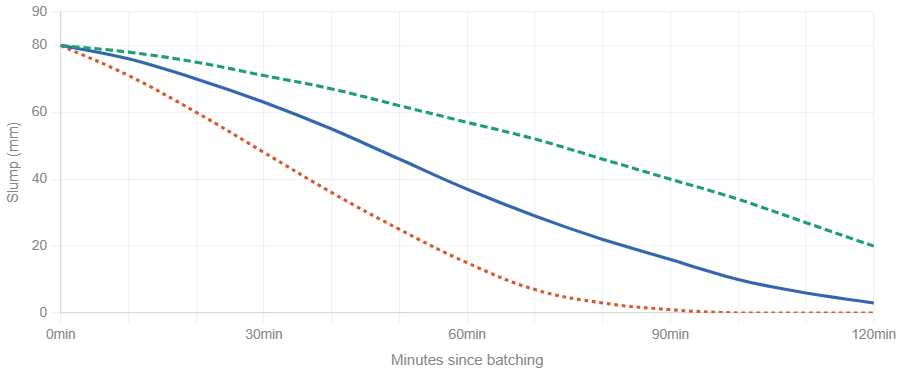
For modern fitouts, commercial office fitouts in Canberra, and speculative suite fitouts where the concrete slab is often the foundation for all subsequent interior work, the practical message is clear. You need a builder and a project management team who understand that concrete scheduling is not simply a logistics exercise. It is a quality control function with direct consequences for the finished product.
A properly managed concrete pour for a warehouse fitout or office fitout project involves coordinating truck arrival sequences, having the labour and equipment staged and ready before the first truck rolls in, and planning the pour sequence so that no load sits spinning in the drum while other work catches up on site.
Can the 90 Minute Window Be Extended?
Yes, it can, but only within specific limits and under carefully controlled conditions. The primary method is the use of chemical admixtures, specifically retarders or water reducing agents known as plasticisers. These slow the hydration reaction and can extend the workable window by 30 minutes or more, depending on the product, the dosage, and the ambient conditions on the day.
If you want to understand how plasticisers actually function in a concrete mix, this detailed guide on what plasticisers are covers the chemistry and practical applications clearly and is worth reading before you specify your next mix.
It is critical to understand that retarders must be specified at the batching plant and incorporated into the mix design. They cannot be added on site after the fact. Any addition of water on site to improve workability is a breach of AS 1379, voids the concrete specification, and fundamentally changes the water to cement ratio in a way that reduces the long term strength of the finished product.
Other practical strategies that help manage the 90 minute window include scheduling pours during the cooler parts of the day, particularly through summer in Canberra, pre-wetting formwork and the sub-base to reduce heat absorption into the fresh concrete, and specifying a mix with a higher initial slump to allow for expected slump loss during transit.
The concrete grade you specify also plays a role here. A higher grade mix generally contains more cement, which means the hydration reaction is more vigorous and the usable window may close sooner than with a standard mix. This is something that should inform your specification from day one, not as an afterthought the morning before the pour.
The type of cement itself also matters considerably. Understanding the differences between cement types helps you select a product whose hydration characteristics suit your project conditions and your available placement window.
Practical Takeaways for Commercial and Fitout Projects in Canberra and NSW
For anyone delivering commercial fitouts across Canberra, NSW, and the broader ACT region, here are the practical lessons from understanding the 90 minute rule properly:
Always confirm the actual batching time from your batch plant, not just the arrival time at your site. The clock starts at batching, not at the gate.
Build transit time into your scheduling realistically. A truck sitting in Canberra traffic for 35 to 40 minutes has used nearly half its window before the chute even goes down.
Have a clear plan for what to do if a load arrives outside the acceptable window. Rejecting a non-conforming load is a real and legitimate option, and sometimes the right one.
Keep accurate site records of discharge times. This is good practice and protects everyone involved if a dispute arises later.
In hot months, have a conversation with your concrete supplier about mix design adjustments before you lock in your pour date, not on the morning of.
Understand that adding water on site to loosen stiff concrete is not a practical solution. It is a specification breach that weakens the finished product and creates liability.
Work With People Who Understand Concrete and Construction
The 90 minute rule sits quietly in the background of every well-run project and loudly in the foreground of every poorly planned one. It is not complicated in concept, but it absolutely requires planning, coordination, and the kind of practical knowledge that only comes from real experience on real sites.
If you are planning commercial office fitouts, shop fitouts in Canberra, budget friendly commercial fitouts in NSW, industrial fitouts, warehouse fitouts, or any kind of build across the ACT and Illawarra region, working with a team that treats concrete scheduling as seriously as design and budget will make a genuine, measurable difference to your outcome.
Ready to Plan Your Next Commercial Project the Right Way?
Virk Construction Management is a fully licensed builder operating across Canberra, ACT, and NSW, with demonstrated experience delivering commercial fitouts, speculative suite fitouts, warehouse fitouts, industrial fitouts, and modern fitouts for a wide range of clients across the region. The team brings a genuinely open book approach to every project, so you always understand exactly what you are getting, why it costs what it costs, and how your build is being managed.
If you are planning a project and want to talk it through with people who actually understand construction from the ground up, get in touch with Virk Construction Management today. The first conversation costs nothing, and the right advice early in a project is worth quite a lot.