
What is the Difference Between Fitout and Refurbishment?

Published by Adeel Virk
Adeel is a founder & project manager at Virk Construction Management, delivering ethical, high-quality residential and commercial projects in NSW and Canberra.
Our have ever tried to describe a construction project to a builder and found yourself halfway through a sentence wondering whether you are talking about a fit out or a refurb, you are not alone. These two terms get used interchangeably all the time across Canberra, NSW, and the ACT, including by people who should probably know better. And for small cosmetic jobs, that confusion mostly does not matter. But when your project involves serious money, a lease agreement, regulatory compliance, or a building that has been standing for 20 years, getting this wrong from the start can cost you more than you think.
The fit out and refurbish difference is not just about language. It shapes how your project is scoped, how it is priced, what trades are involved, how long it takes, and what approvals you need to obtain before anyone swings a hammer.
Planning a Fit Out or Refurbishment Project?
Get in touch with Virk Construction Management today to discuss your fit out or refurbishment project. You receive practical advice, transparent pricing, and experienced project delivery across Canberra, ACT, and NSW.
Contact the Virk TeamWhat is a Fit Out?
A fitout is the process of turning an empty, unfinished interior space into something functional and ready for occupation. The starting condition is always a blank slate. Think of a brand new commercial tenancy in a Canberra office building, freshly handed over by the developer. The structural shell is there. The slab is poured. There may be a basic electrical board and rough plumbing provisions. But there are no internal partitions, no ceiling system, no floor finish, no joinery, no lighting that actually works for a business, and no character to the space whatsoever. A fitout is everything that happens between that raw condition and the day someone walks in and gets to work. In commercial construction across the ACT and NSW, fitouts are typically divided into three levels.
Shell and Core
This is the base building condition as handed over by the developer or landlord. The structural frame, external facade, lifts and lobbies, and central building services are in place, but the tenancy itself is untouched. There is nothing inside the lettable area beyond a concrete floor and some rough service connections.
Category A Fit Out
Category A covers the foundational finishes and services that make a space technically habitable without any specific tenant in mind. This typically includes:
Finished floor, either polished concrete or raised access flooring
Suspended ceiling grid with basic recessed lighting
Mechanical air conditioning is distributed to the floor
Fire detection systems and sprinklers
Toilets and base-level amenities
Power and data risers brought to the tenancy
Category A is what most commercial landlords provide to attract tenants before signing leases. It is functional. It is generic. And a tenant moving into a Category A space still needs to do a significant amount of work before it feels like their space.
Category B Fit Out
This is where most businesses spend their money. Category B is the transformation of a Category A shell into a working, branded, specific environment. Internal partition walls, custom joinery, kitchen and breakout areas, reception fit outs, meeting room glazing, feature lighting, branded wall finishes, furniture coordination. Everything that makes a space specific to the people who use it. If you are planning a commercial office fitout in Canberra, a Category B scope is almost certainly what you are dealing with.
What is a Refurbishment?
A refurbishment is fundamentally different in one key way: the space already exists and has been occupied, sometimes for years or even decades. You are not working with a blank canvas. You are working with an existing interior that needs updating, improving, or restructuring in some form.
The scope of a refurbishment can range from light cosmetic work all the way through to a full strip out and rebuild. At the lighter end, it might mean replacing worn flooring, repainting throughout, updating light fixtures, and refreshing dated joinery. At the heavier end, it could mean demolishing most of the existing interior and rebuilding it to a new design, which starts to look a lot like a fitout, and that is precisely where the confusion tends to creep in.
The defining characteristic of a refurbishment is that it responds to what already exists. Before the design can be finalised, someone has to assess the existing conditions. What services are currently running behind those walls? What is the condition of the structure? Is the existing HVAC worth upgrading or replacing entirely? Are there compliance gaps in the original build that need to be rectified? These questions do not come up in a standard fitout of a new tenancy. They are central to every refurbishment brief.
Types of Refurbishment
Cosmetic refurbishment involves surface-level updates only. Painting, new flooring, updated lighting, and minor joinery refresh. Short program, minimal disruption, and relatively predictable cost.
Partial refurbishment focuses on specific zones or systems within a building. A new kitchen, a reconfigured open plan area, a bathroom upgrade, or a modernised facade, all while the rest of the building remains in use. This requires careful staging and sequencing to keep disruption manageable.
Full strip out and refit is the most intensive form. The existing interior is demolished back to the base building, and the space is completely redesigned and rebuilt. This is the refurbishment scope that gets confused with a fit-out most often, but the difference remains: the starting conditions are an existing building with existing constraints, not a fresh tenancy.
For residential projects, a house renovation in Canberra follows this same logic. Every decision about layout, structure, and services is shaped by what is already there.
Fitout vs Refurb: The Core Differences
| Factor | Fit Out | Refurbishment |
|---|---|---|
| Starting condition | Empty shell or Category A space | Existing occupied or previously occupied space |
| Existing services | Minimal or none within the tenancy | Present and must be assessed before design |
| Design process | Designed from a blank canvas | Constrained by existing structure and services |
| Demolition required | Only builder's finish strip out | May involve significant demo of existing fit |
| Approval requirements | Building approval for new fitout works | May require DA depending on extent of changes |
| Program certainty | High: scope is defined from the start | Lower: unknowns in existing conditions create variables |
| Cost certainty | Easier to price with a clean scope | Higher contingency needed due to hidden conditions |
| Occupation during works | Typically a vacant tenancy | Sometimes partially occupied; staging is critical |
| Heritage considerations | Rarely applicable | May apply depending on building age and class |
| Sustainability opportunity | Efficiency built in from the start | Chance to upgrade old, inefficient existing systems |
When Do You Need One Over the Other?
The project determines the category, not a preference for one term over another. But the scenarios that point toward each are usually pretty clear.
A fit out is the right framing when:
You have just signed a lease on a new commercial tenancy in Canberra or anywhere across the ACT region
You are entering a shell and core space in a recently completed development
You are subdividing an existing tenancy into two separate, independently fitted spaces
You are building a new commercial space as part of a new construction project, and construction project development is part of your brief.
A refurbishment is the right framing when:
Your existing office, retail space, or home needs updating but the structure is sound and worth keeping
A building that has been in use for 10 or more years needs its services, finishes, or layout brought up to current standards
You are repositioning a commercial asset for sale or re-lease and need to lift its condition and appeal
You are dealing with compliance issues in an existing building, such as access upgrades, fire safety updates, or asbestos management as part of a building improvement program.
For projects that genuinely sit between these two categories, such as a full strip out refurbishment where everything is replaced, it is worth working with a construction management professional who can assess the existing conditions objectively and advise on how to scope and price the work before you commit to a contract.
Where the Two Overlap (and Why People Get Confused)
The reason people mix these terms up so often is that a full refurbishment and a Category B fit out can look almost identical on site once the existing interior has been stripped back to the structure. The same trades are working. The same finishes are being applied. The same project management challenges appear. The difference is in what was there before and how the existing building shaped every decision that got you to that point.
There is also a meaningful overlap in how projects are priced. A construction team working under an open book cost plus model will account for the unknowns in a refurbishment differently to how they approach a clean fit out scope. In a fit out, the pricing is built on a reasonably knowable set of conditions. In a refurbishment, the contingency allowances tend to be larger because existing conditions introduce variables that are genuinely difficult to foresee until walls open up and the building starts telling you things the drawings never showed.
Understanding the scope of construction management before you engage anyone for either type of project goes a long way toward setting realistic expectations on both sides.
Cost Considerations for Canberra and ACT Projects
Canberra has a specific cost environment. The labour market is tight, the contractor pool is smaller than in Sydney or Melbourne, and compliance under ACT legislation adds its own layer of complexity. For a broader reference point on what construction in this region actually costs, the breakdown on how much it costs to build in Canberra is worth reading.
For commercial projects, here is a rough cost guide:
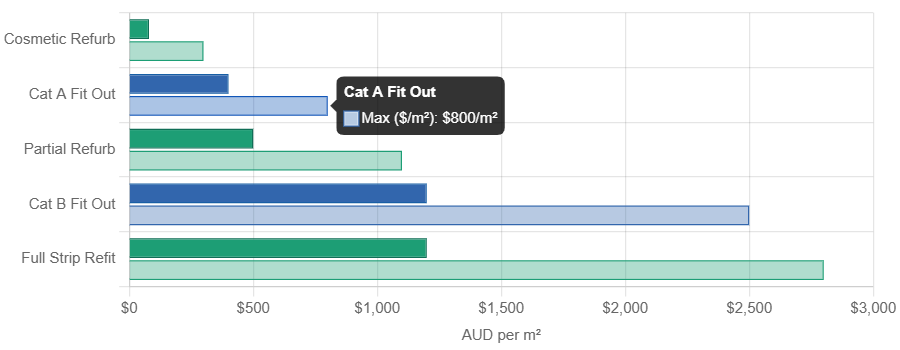
Cosmetic refurbishment: $80 to $300 per square metre
Category A fit out: $400 to $800 per square metre
Partial refurbishment: $500 to $1,100 per square metre
Category B fit out: $1,200 to $2,500 per square metre
Full strip out and refit: $1,200 to $2,800 per square metre
The chart below shows these ranges visually to make the comparison easier.
Choosing the Right Approach for Your Project
The practical takeaway from all of this is straightforward. Before you brief anyone, before you get a quote, and before you sign anything, you need to know which of these two things you are actually doing. Because the questions you need answered are different, the risks you need to manage are different, and the type of expertise you need on your side is different.
A fit out, particularly Category B, is largely about design execution and trade coordination in a controlled, predictable environment. A refurbishment, especially a full one, is about risk management as much as it is about construction. Existing buildings have stories. They have hidden services, non-compliant finishes from previous eras, and structural quirks that only show up when you open things up. The better your management team is at reading those risks upfront and pricing them honestly, the better your outcome will be.
If your project sits anywhere in that middle ground between a cosmetic refurb and a full Category B fit out, the Knockdown and Rebuild option is also worth understanding. Sometimes the numbers make more sense when you start completely fresh rather than fighting the existing building through a complex refurbishment program.
Ready to Start Your Project in Canberra or NSW?
Whether you are planning a commercial fit out, a home refurbishment, or something in between, Virk Construction Management works with clients across Canberra, ACT, and NSW to deliver projects with full cost transparency and proper management from day one.
With an A-Class Builder's License in both the ACT and NSW, and over 17 years of combined industry experience across residential and commercial work, the team at Virk understands the specific compliance environment, contractor market, and cost conditions that shape every project in this region.