
What Are the 5 Tests of Cement? A Complete Guide

Published by Adeel Virk
Adeel is a founder & project manager at Virk Construction Management, delivering ethical, high-quality residential and commercial projects in NSW and Canberra.
Cement is arguably the most important binding material in any construction project, yet it is also one of the most overlooked when it comes to quality verification on site. Most property owners in Canberra and across the ACT and NSW regions trust that the bag of cement their builder orders from a supplier is fit for purpose. Sometimes that trust is well placed. Other times, a batch of cement that looks perfectly normal can fail silently inside a structure, leading to cracking, premature deterioration, or worse.
This is exactly why standardised testing exists. There are five fundamental tests of cement that engineers and construction professionals use to verify quality before any cement goes into footings, slabs, columns, or structural walls. Understanding what these tests measure, how they are conducted, and what the results actually mean can help you ask the right questions on any project, whether you are building a new home, managing a commercial fitout, or overseeing a large residential development in the ACT region.
If you want to understand how material decisions like this one sit within the broader construction process, our guide on how construction project development works in Canberra covers the full picture from feasibility through to delivery.
Why Cement Testing Actually Matters on Australian Projects?
Cement quality is not uniform across suppliers, storage conditions, or manufacturing batches. Cement that has been stored improperly, exposed to moisture, or manufactured with slightly off proportions can behave very differently once it reaches the mixing stage. In Australia, cement quality is governed by AS 3972, which outlines the requirements for general purpose and blended cements. But standards on paper do not automatically mean every bag on every site meets those requirements.
The five tests of cement are the practical checkpoint between a standard and real-world performance. They are not overly complicated in concept, but each one measures a property that directly affects how cement will behave in a finished structure.
Know Exactly Where Every Dollar Goes
Unlike traditional builders, Virk Construction Management operates on a genuine Open Book model. You see exactly what materials are being used, where they are sourced from, and what they cost. No hidden margins. No unexpected surprises. Just complete transparency from planning through to project completion.
The 5 Tests of Cement Explained
1. Consistency Test of Cement
What it measures: The water content needed to produce a cement paste of standard workable consistency, which then becomes the baseline for other tests including setting time and soundness.
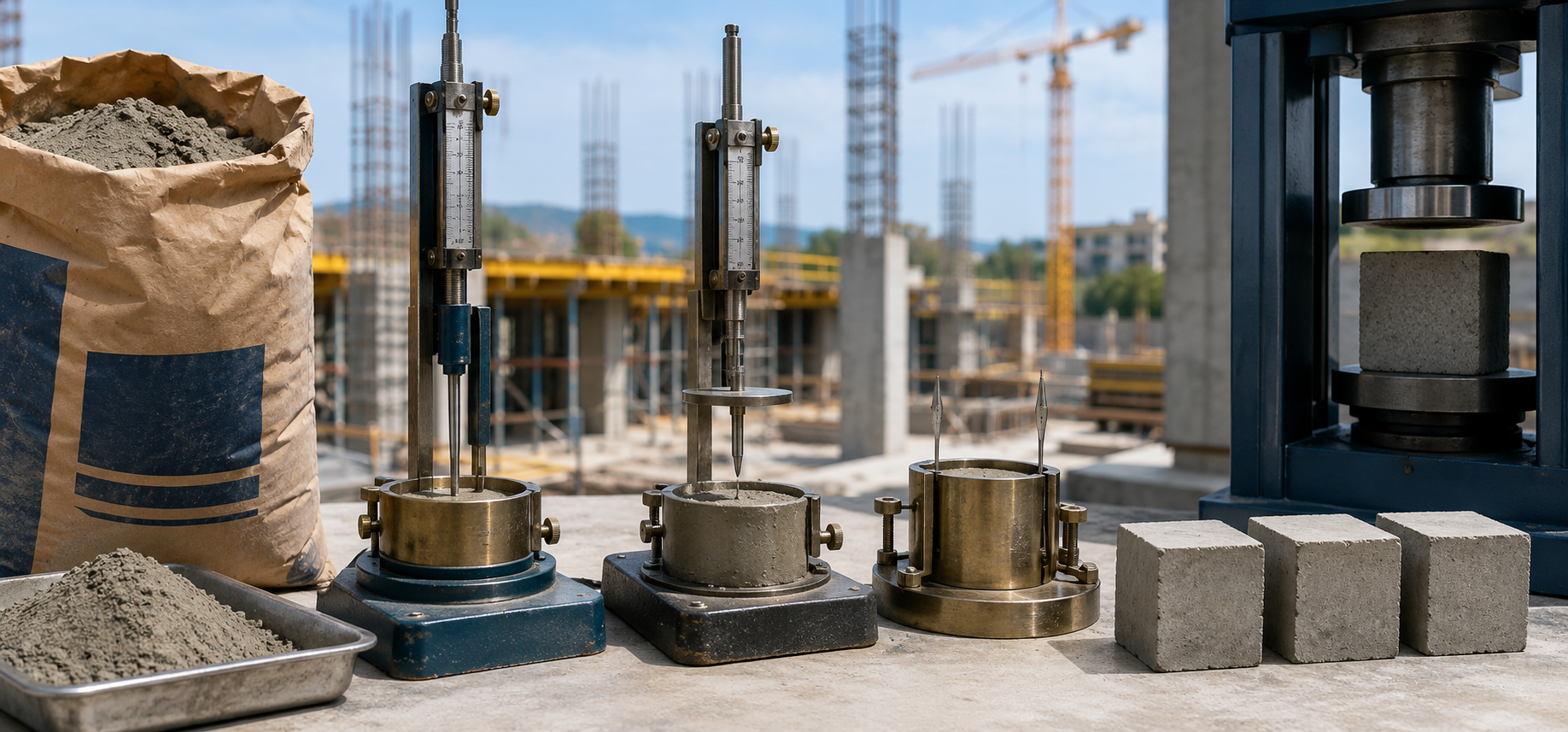
How it works: A Vicat apparatus is used for this test. A specific quantity of cement is mixed with a known amount of water, and the plunger of the Vicat apparatus is lowered onto the paste. Standard consistency is achieved when the plunger penetrates to a depth of 5 to 7 mm from the bottom of the mould, which typically indicates a paste of 26 to 33 percent water by weight of cement.
Why it matters: If the standard consistency is not established first, every subsequent test that uses a cement paste becomes unreliable. The consistency test is essentially the calibration step for the entire testing sequence. On a construction site in Canberra, where temperature and humidity vary considerably between seasons, water demand can shift even within the same cement type, so this test provides a practical anchor point.
This test also has implications for concrete mix design. If a cement has unusually high water demand, the water to cement ratio in your mix will shift, which directly affects compressive strength and long-term durability. For a deeper look at how cement types influence mix behaviour, our article on OPC versus PPC for plaster explains the differences in practical terms.
2. Setting Time Test of Cement
What it measures: Initial setting time (when cement paste loses workability) and final setting time (when it becomes a rigid mass), both measured using the Vicat apparatus.
How it works: The same Vicat apparatus used in the consistency test is applied here, but with a needle attachment. For initial setting time, the needle is lowered onto the paste at regular intervals. When the needle fails to penetrate to within 5 mm of the base, initial set has been reached. For final setting time, a different needle with an annular attachment is used, and the test continues until the needle makes an impression on the surface without the annular ring leaving a mark.
Standard requirements under AS 3972:
Initial setting time: not less than 45 minutes
Final setting time: not more than 600 minutes (10 hours) for general purpose cement
Why it matters: Setting time governs workability on site. If cement sets too quickly, concrete or mortar cannot be placed, compacted, and finished before it stiffens. If it sets too slowly, formwork cannot be stripped on time, work schedules fall apart, and in extreme cases the early strength gain becomes inadequate. This is a direct project management concern, not just a materials one. We have covered what actually happens structurally when cement sets too slowly in a separate article: What Happens If Cement Sets Too Slowly?
Admixtures like plasticizers can also influence setting time, which is worth understanding if your project uses chemical additives in the mix. Our guide on what a plasticizer is and how it works covers this in full.
3. Soundness Test of Cement
What it measures: Whether cement expands excessively after hardening due to the presence of free lime (CaO), free magnesia (MgO), or excess calcium sulfate.
How it works: The Le Chatelier test is the standard method used. Cement paste of standard consistency is placed in a Le Chatelier mould, which is a cylindrical split mould with indicator needles on either side. The mould is submerged in water and boiled for one hour to accelerate the expansion process. The distance between the indicator needles before and after boiling is measured. Expansion must not exceed 10 mm for the cement to be considered sound. For a more thorough check on magnesia content, the autoclave expansion test is also used, particularly in research or quality assurance settings.
Why it matters: Unsound cement is dangerous in a way that is not immediately visible. It produces a paste that initially appears to set normally, but then continues to expand after hardening. That expansion creates internal tensile stresses that manifest as cracking, spalling, and eventually structural failure months or years down the track. For builders and property owners in NSW and the ACT, where residential builds are expected to perform for decades, using unsound cement is a risk that no competent construction team would accept.
4. Compressive Strength Test of Cement
What it measures: The load bearing capacity of hardened cement mortar at specified ages, typically 3 days, 7 days, and 28 days.
How it works: Standard cement mortar cubes are prepared using a cement to standard sand ratio of 1:3 by weight, with a water to cement ratio determined by the flow test. The cubes are cast in 70.6 mm moulds, cured under water at a controlled temperature of 27 degrees Celsius, and then tested under a compression testing machine at each specified age. Results are reported in megapascals (MPa).
Minimum compressive strength requirements for general purpose cement (GP) per AS 3972:
Why it matters: Compressive strength is the most direct indicator of structural performance. It determines whether a concrete element, whether a footing, a suspended slab, or a column, will carry the loads it was designed for. Every concrete grade specification, from M20 to M25 and beyond, traces back to the cement's own compressive strength contribution to the final mix.
On projects in Canberra and the ACT region, where concrete is often specified to meet particular performance grades for residential or commercial structures, understanding how cement strength is tested helps owners and builders interpret test certificates from suppliers with greater confidence.
5. Fineness Test of Cement
What it measures: The particle size of cement, which directly influences its surface area and therefore its reactivity with water.
How it works: Two methods are commonly used. The sieve method passes a weighed sample of cement through a 90-micron (IS 90 μm) sieve. The residue left on the sieve is weighed, and fineness is expressed as a percentage. For general purpose cement, this residue should not exceed 10 percent. The air permeability method (Blaine test) is more precise and measures the specific surface area in square centimetres per gram, with a typical requirement of not less than 225 m²/kg for ordinary Portland cement and higher values for rapid-hardening types.
Why it matters: Finer cement particles have greater surface area exposed for hydration, which means they react faster with water and produce higher early strength. However, very fine cement also increases the heat of hydration and water demand, which can be a disadvantage in large pours or hot weather conditions like those seen in Canberra summers. Coarser cement gains strength more slowly but can be more economical and is less susceptible to cracking from thermal effects.
Understanding fineness also helps explain why different cement grades and types behave differently in practice. Our post on which grade of OPC is best explores this relationship further if you are selecting cement for a specific application.
Quick Reference: The 5 Cement Tests at a Glance
Compressive Strength Development Over Time
The chart below shows how general-purpose cement typically develops compressive strength from 3 days through to 28 days, illustrating why the 28-day result is the standard benchmark for structural specification.
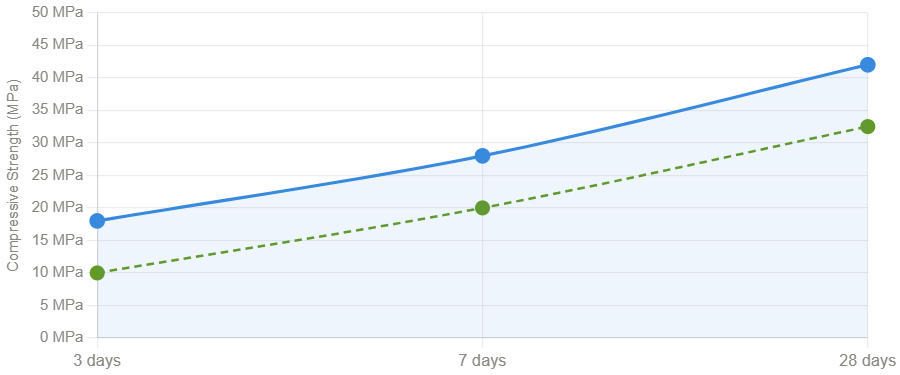
The chart shows the typical compressive strength trajectory of general-purpose cement versus the AS 3972 minimum requirements at 3, 7, and 28 days. Quality cement comfortably exceeds the minimums at every age interval, giving structural designers the safety margin they need.
How Do These 5 Tests Connect to Each Other?
The five tests are not independent checkboxes. They form a logical sequence where each result informs the next. Consistency establishes the correct water content, which is then used to prepare paste samples for the setting time and soundness tests. The compressive strength test uses a related mix design principle, while fineness underpins the explanation for why all four preceding results land where they do. Finer cement sets faster, develops strength earlier, and requires more careful monitoring for soundness issues because the rapid hydration reaction accelerates everything, including any expansion from problematic compounds.
This sequence matters on real projects because a problem in one test can almost always be traced back through the chain to fineness or water demand. Experienced construction managers look at the full test certificate rather than isolating individual results, because a cement that passes every individual test by a narrow margin may still behave unpredictably when those marginal results compound.
Understanding how different types of cement perform across these tests is also valuable context, since Type III (rapid hardening) cement, for example, will show markedly different fineness and early strength figures compared to a standard Type I general purpose cement.
Practical Implications for Canberra and ACT Construction Projects
In the ACT region, residential and commercial construction must comply with the National Construction Code and relevant Australian Standards. Cement test certificates from suppliers are a routine part of quality assurance documentation, but site teams do not always scrutinise them closely unless they are working under a rigorous quality plan.
For owner-builders, developers, or anyone managing a project on a cost-plus basis, knowing what these five tests measure gives you the ability to ask your builder or construction manager meaningful questions about the materials going into your project. If a project involves a concrete specification for structural elements, asking to sight the supplier's test certificate is reasonable and entirely appropriate.
The cost plus construction model that Virk Construction Management operates under means clients have full visibility into material procurement, including the opportunity to verify that the cement and concrete being used meets the specified performance standards, rather than simply accepting whatever the builder orders.
Ready to Build With a Team That Actually Understands Materials?
At Virk Construction Management, we bring over 17 years of combined experience to residential and commercial projects across Canberra, the ACT, and NSW. Whether you are planning a new home, a knockdown rebuild, or a commercial fitout in Canberra, our team manages every aspect of quality, procurement, and compliance on your behalf.