
How to Check for Squareness? The Complete Guide

Published by Adeel Virk
Adeel is a founder & project manager at Virk Construction Management, delivering ethical, high-quality residential and commercial projects in NSW and Canberra.
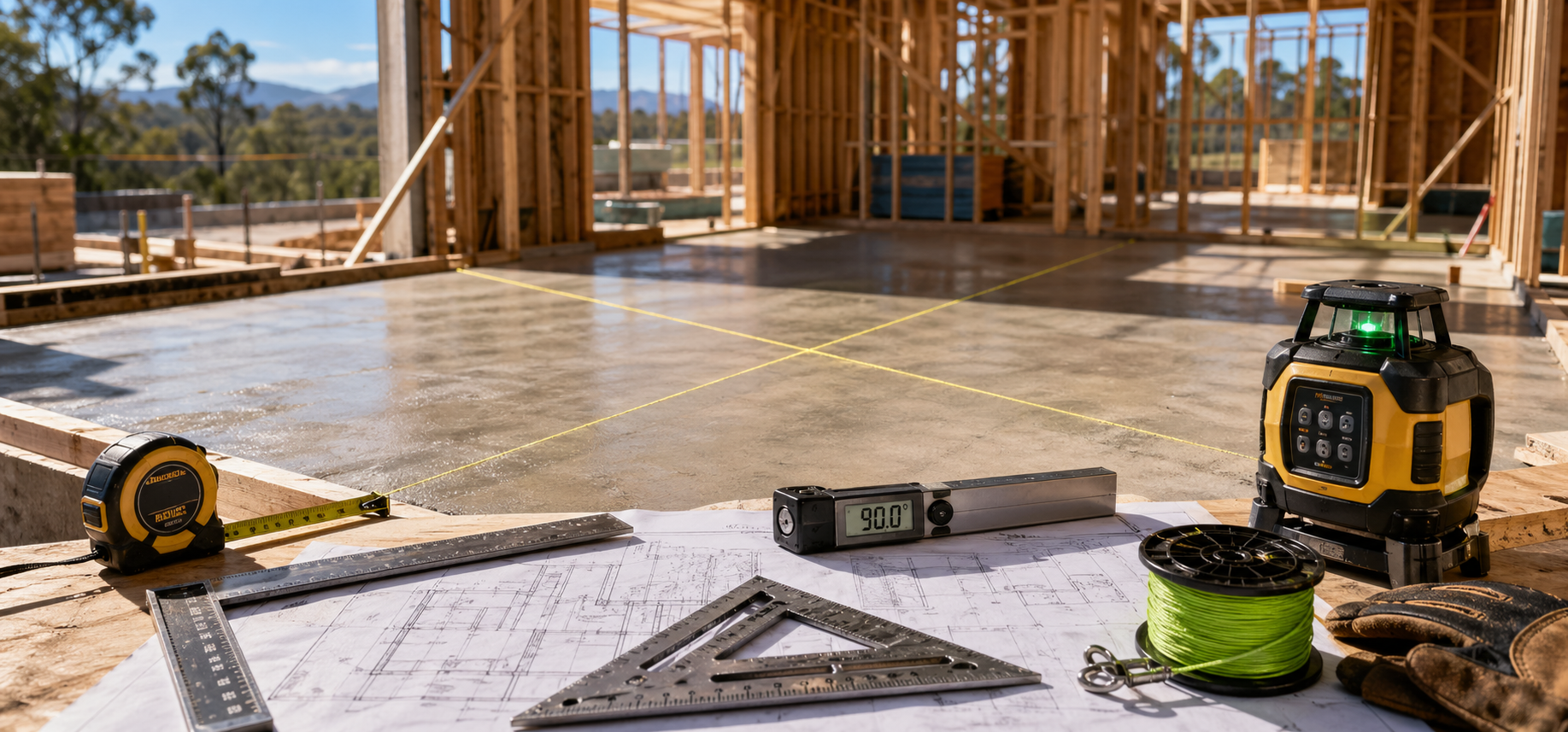
There is a moment on almost every construction site where someone pulls out a tape measure, checks a corner, and says nothing for about three seconds too long. That pause usually means the same thing. Something is off square. And depending on how far along the build is, that pause can cost a few minutes or a few thousand dollars.
Squareness is one of those foundational checks that experienced builders in Canberra, the ACT, and across NSW take seriously from day one. It is the kind of technical detail that does not get much attention until something goes wrong, and then it becomes the only thing anyone wants to talk about.
This guide covers every practical method for checking squareness, from the old-school 3-4-5 triangle rule to laser levels, with clear explanations of when and why each method applies during a build.
What Does "Square" Actually Mean in Construction?
In construction, "square" means that two surfaces or structural elements meet at a precise 90-degree angle. A corner is square when the angle between two walls, two floor edges, or two framing members is exactly perpendicular.
This sounds simple, and in principle it is. The challenge is that most materials flex, settle, and shift during installation. Timber frames move. Concrete slabs cure unevenly. Steel can bow slightly under load. Without systematic squareness checks at each stage, those tiny deviations compound into serious alignment problems by the time the fit-out begins.
The 90 Degree Principle
Every rectangular structure, whether it is a single room or a full residential build, relies on four corners, each sitting at 90 degrees. If even one corner drifts a degree or two, the opposite diagonal measurement will not match, and everything installed afterward, including tiles, cabinetry, door frames, and flooring, will fight against that skew.
This is also directly related to the concepts of plumb and level. Understanding the difference between plumb and level is the first step toward grasping why squareness matters in three dimensions, not just on a flat plane.
Why Checking for Squareness Matters
Impact on Structural Integrity
A frame that is out of square puts an uneven load on joints, connections, and fixings. Over time, racking forces in the structure distribute differently than the engineer intended. In bushfire zones and high wind areas common across the ACT and southern NSW, this kind of structural deviation is not something to leave for the certifier to catch at handover.
Cost Implications for Your Build
The later a squareness problem is found, the more expensive it is to correct. A slab poured slightly out of square may only require minor adjustment during framing. The same error discovered during tiling will mean pulling up laid material, re-screeding, and re-tiling at full cost. If you are planning a new build and want to understand how these quality issues affect the overall budget, reading through how much it costs to build a house in Canberra gives a useful cost context for why getting the basics right early matters so much.
How to Check for Squareness: 5 Proven Methods
Method 1: The 3-4-5 Triangle Rule (Pythagorean Theorem)
This is the oldest and most reliable method used by builders and site supervisors across Australia. It comes directly from the Pythagorean theorem: in a right triangle, the square of the hypotenuse equals the sum of the squares of the other two sides.
Here is how to apply it on site:
Mark a point at the corner you want to check
Measure 3 units along one wall and mark that point
Measure 4 units along the adjacent wall and mark that point
Measure the diagonal between those two marks
If the diagonal measures exactly 5 units, the corner is square. The units do not matter as long as they are consistent. You can use 600mm, 800mm, and 1000mm for a compact check, or scale up to 3000mm, 4000mm, and 5000mm for large slab or formwork work.
This method requires no special tools and works on any surface. It is the go-to check at the slab stage and during wall framing.
Method 2: Diagonal Measurement Method
For rectangular spaces, this method is fast and effective. The principle is straightforward: if a rectangle is truly square, both diagonals will measure the same length.
Steps to follow:
Measure from corner A to corner C (one diagonal)
Measure from corner B to corner D (the other diagonal)
Compare both measurements
A difference of more than 3mm across a standard room indicates the space is out of square. This method is especially useful when setting out formwork before a slab pour, checking a frame before sheeting, and verifying that a room is square before tiling begins.
It is worth combining this check with a wall flatness check. How to check if a wall is perfectly flat covers the complementary inspection that tells you whether your surfaces are both flat and plumb, which matters just as much once framing is up.
Method 3: Using a Framing Square or Speed Square
A framing square is an L-shaped tool with arms typically 600mm and 400mm. It is designed to check 90-degree angles directly. A speed square is a smaller triangular version that does the same job in tighter spaces.
These tools are used for:
Checking individual stud and noggin connections
Verifying window and door rough openings
Confirming rafter and truss seat cuts
Spot checking after timber frame installations
The limitation of framing squares is their size. They are reliable for small-scale checks but cannot confirm whether a full room or building footprint is square. Use them for component-level verification and rely on the diagonal method for larger areas.
Method 4: Digital Angle Finders and Laser Levels
Modern construction in Canberra increasingly uses digital tools for squareness verification. A digital angle finder clips onto surfaces and gives a precise angle reading to within 0.1 degrees. Rotary laser levels can project a horizontal and vertical plane simultaneously, making it possible to check squareness across a large floor or wall area quickly.
The advantages of digital methods include:
Higher accuracy than tape measure methods on large spans
Faster setup on complex floor plans
Data that can be recorded and included in inspection reports
Compatibility with Building Information Modelling workflows
Self-leveling laser levels are now standard on most professional construction sites and are particularly useful when construction project development involves multi-storey structures where floor-to-floor alignment is critical.
Method 5: String Line Method
String lines stretched tightly across corners are one of the most practical methods for site set out and checking squareness across large areas. When two string lines cross at a corner, the angle at which they cross can be verified using the 3-4-5 method or a digital tool.
This method works well for:
The initial slab is set out before the concrete is poured
Brick and block layout verification
Large commercial floors and carpark structures
Setting out for tiled areas with diagonal patterns
String lines lose accuracy over long spans if they sag, so always ensure adequate tension and support the line at intervals no greater than 10 metres.
Australian Construction Squareness Tolerances
The following table outlines the accepted squareness tolerances referenced in Australian Standards and common practice across ACT and NSW construction:
These tolerances are not suggestions. They are the benchmarks that certifiers and building inspectors use during staged inspections. Exceeding them can result in failed inspections, required rectification works, and delayed certificates of occupancy.
When to Check for Squareness During a Build
Squareness checks are not a once-off task. They should be built into the inspection and test plan at every major stage of a project. The key milestones where squareness verification is required include:
During site set out: Before any excavation or formwork is placed, string line checks confirm the building footprint is positioned and oriented correctly
After formwork is erected, before concrete is poured, the formwork corners must be checked using the diagonal method
After slab pour and cure: Once the slab reaches sufficient strength, confirm corners are within tolerance before framing begins.
After wall framing: Check each room individually using both the diagonal method and a framing square on critical connections.
Before wet area tiling: Out-of-square wet areas cause grout line issues that are expensive to correct once tiles are laid.
Before cabinetry installation: Kitchens and bathrooms require square rooms, or compensation scribing will be needed at every junction
Understanding what a scope of construction management covers will show you how squareness verification fits into the broader quality assurance framework that professional construction managers use to protect the client's interests at each stage.
Common Squareness Errors and How to Fix Them
Error: Slab corners out of square by more than tolerance. This is discovered during the framing set out. The fix at this stage is to adjust the wall frame layout to compensate, or in severe cases, grind and re-trowel the slab edge. Catching this before the pour is always better.
Error: Framed walls are out of plumb and square after installation. This occurs when bracing is insufficient before sheeting is applied. The fix is to apply temporary bracing before permanent fixing and check squareness before any internal linings are installed.
Error: Tiling layout drifting out of square across a floor. Typically caused by not establishing a true square reference line before laying begins. The fix during installation is to re-snap chalk lines from a verified square starting point. After the fact, affected tiles must be removed and relaid.
Error: Door openings narrowing or widening from floor to head.d This usually reflects a plumb issue in the framing rather than a squareness issue, but the two are connected. Check both the plumb of the studs and the square of the rough opening before fixing frames.
Here is a breakdown of how often each squareness checking method is used across typical residential and commercial projects in Canberra and NSW:
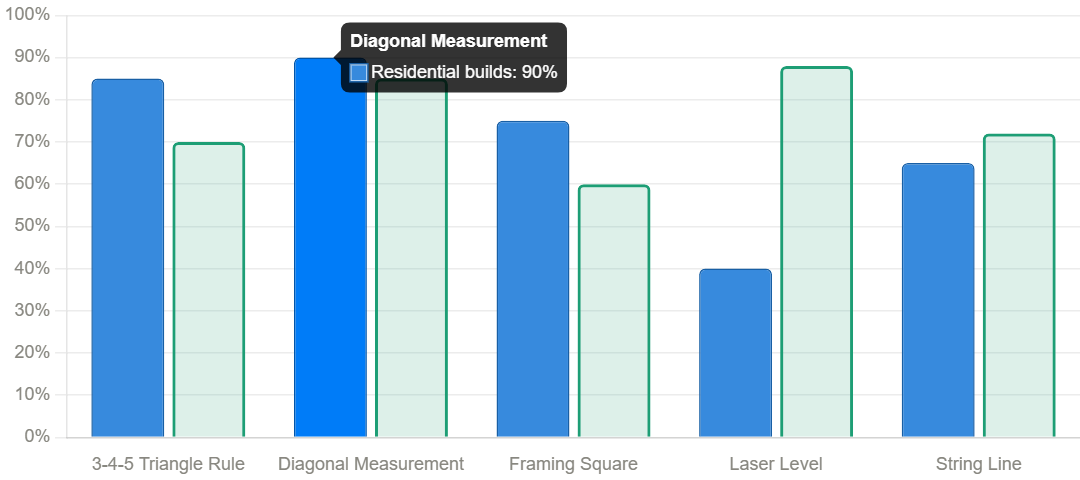
The chart above shows how frequently each method is used on residential versus commercial sites across the region. Laser levels dominate on commercial projects, while the classic diagonal measurement method remains the most universally applied check across both build types.
The Connection Between Squareness, Quality, and Project Outcomes
Squareness is not just a technical checkbox. It is a signal of the overall quality management system operating on a site. When every corner is verified at each stage, it reflects a construction team that checks work in progress rather than discovering problems at handover.
For anyone considering a new residential build, knockdown rebuild, or commercial fitout in Canberra or the ACT, the quality of construction monitoring at each stage makes a significant difference in final outcomes. Looking through the construction services offered by Virk Construction Management gives a clear picture of how a properly managed build is structured from set out to completion.
Also, knowing which tools are most commonly used in construction helps owners understand what professional builders bring to site and why those tools matter for quality checks like squareness verification.
Ready to Build With a Team That Gets the Details Right?
If you are planning a residential build, renovation, or commercial fitout in Canberra, the ACT, or NSW, the technical details covered in this guide are exactly the kind of things the team at Virk Construction Management monitors at every stage of a project.
With an active A-Class Builder's License in both the ACT and NSW, and over 17 years of combined industry experience, Virk Construction Management delivers builds where squareness checks, quality audits, and inspection protocols are part of the standard process rather than an afterthought.
Their Open Book Cost Plus model also means you see exactly where your money goes, with no hidden variations sitting behind quality shortcuts.
Get in touch with the Virk Construction Management team today to discuss your upcoming project and find out how professional construction management protects your investment from the first peg in the ground to the final handover inspection.
Virk Construction Management serves clients across Canberra, the ACT, and NSW. ACT Builders License: 202441546 | NSW Builders License: 472308C