
What Are the Four Types of Remodeling? A Complete Guide

Published by Adeel Virk
Adeel is a founder & project manager at Virk Construction Management, delivering ethical, high-quality residential and commercial projects in NSW and Canberra.
Commercial property owners across Canberra, the ACT, and NSW often use the word remodeling loosely, applying it to everything from a fresh coat of paint to a full structural overhaul. This lack of precision creates real problems once a project starts, because the ACT's dual-layer approval system, which runs Development Applications through the Planning Authority separately from Building Approvals issued by a licensed certifier, treats each remodeling category differently. Knowing exactly which category a project falls into changes the permits required, the trades involved, and the timeline a business should expect.
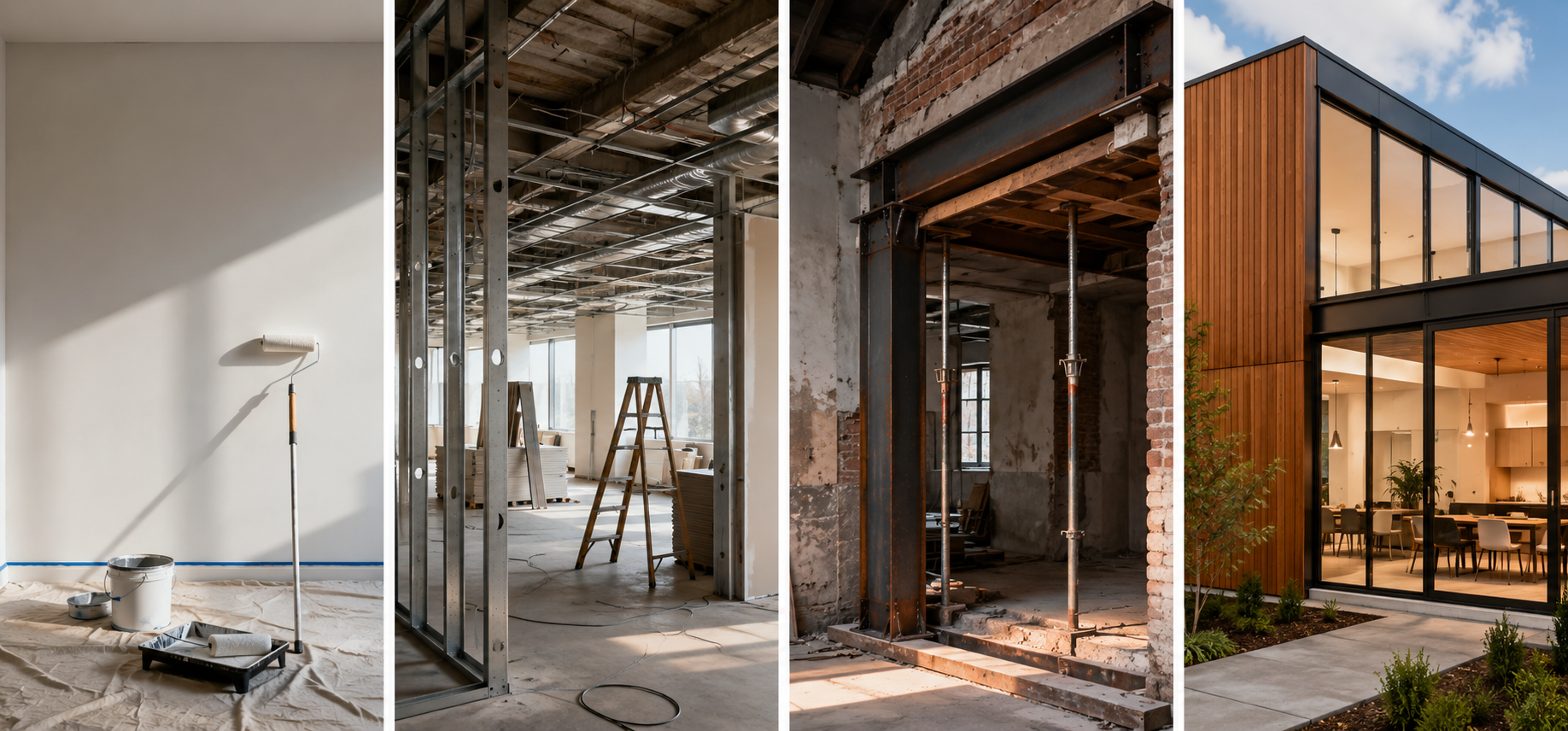
Remodeling splits into four distinct categories: cosmetic remodeling, fitout remodeling, structural remodeling, and addition remodeling. Each category carries its own technical requirements, its own approval pathway, and its own risk profile. This guide breaks down all four with the level of technical detail a Canberra business owner actually needs before briefing a contractor.
Why the Distinction Matters For Canberra Businesses
Under the ACT's Building Act 2004, a Building Approval is a separate document from planning consent. Many business owners assume that if council approves the concept, the builder can start immediately. In practice, a certifier still has to issue a Building Approval based on engineering documentation, and for anything beyond cosmetic work, that documentation has to demonstrate compliance with the relevant sections of the National Construction Code.
Getting the category wrong at the briefing stage is the most common cause of budget blowouts we see. A business that briefs a contractor for a "quick refresh" but actually needs partition changes near a fire-rated corridor will be told mid-project that a fire engineer needs to sign off before work continues, because AS 1668.1 governs ventilation and smoke control near fire compartments. That kind of correction, discovered halfway through, costs more than getting the scope right from the start. Our guide on fitout budgeting for Canberra businesses walks through how these hidden scope shifts affect final cost. For the specific line between remodeling and a full refurbishment, see our article on the difference between fit out and refurbishment.
The Four Types of Remodeling
1. Cosmetic Remodeling
Cosmetic remodeling covers surface-level changes that do not touch load paths, wet areas, or electrical circuits beyond fixture swaps. It is the only category of the four that usually avoids both a Development Application and a Building Approval, provided the property sits outside a heritage precinct.
Typical cosmetic remodeling work includes:
Repainting using low VOC coatings compliant with AS/NZS 2311, now standard practice for occupied commercial spaces
Replacing floor coverings, including slip resistance testing under AS 4586 for wet or high-traffic areas such as cafe entries
Swapping light fittings on existing circuits without altering the switchboard
Refreshing joinery faces, benchtops, or cabinet hardware
Updating exterior signage within the ACT's signage code limits for the relevant zone
The exception that catches businesses off guard sits in Canberra's heritage precincts. Properties in parts of Manuka, Braddon's older warehouse stock, and sections of Kingston Foreshore fall under heritage overlays that require a referral even for repainting if the building facade is a listed element. Confirming heritage status through Access Canberra's property database before scheduling any exterior work avoids a stop-work notice partway through.
Because cosmetic remodeling does not require trade certification beyond the painter or flooring installer's own licensing, most projects complete in one to three weeks with no disruption to trading hours if scheduled after close.
2. Fitout Remodeling
Fitout remodeling reconfigures how a space functions. It sits between cosmetic work and structural change because it can involve moving non-load-bearing partitions, rerouting data and power, and adjusting mechanical services, without touching anything that carries building load.
Common elements of fitout remodeling include:
Removing or adding stud partitions built to non-load-bearing specification
Rewiring data and power distribution to AS/NZS 3000, particularly when workstation density increases beyond what the original circuit design allowed
Rezoning HVAC to match a new floor plan, which often requires a mechanical engineer to confirm the existing system's capacity under AS 1668.2
Adjusting fire egress paths, which triggers a review against the Building Code of Australia's deemed to satisfy provisions for travel distance
Installing new kitchenettes or breakout areas, which usually requires a plumber for wet area work even if walls do not move.
This is the category where most Canberra office and retail businesses spend the largest share of their remodeling budget, since it directly shapes daily operations. We manage this scope regularly across office fitouts in the ACT; examples are on our office fitouts Canberra page.
A detail specific to multi-tenant buildings in precincts like Barton and Deakin: base building fire systems are managed by the property's Building Management Committee, not the tenant. Any partition change near a smoke detector, sprinkler head, or fire door requires written sign-off from the base building's fire engineer before a certifier will issue Building Approval for the tenant fitout. This step alone can add two to three weeks to a project timeline if not factored in early.
3. Structural Remodeling
Structural remodeling changes load-bearing elements, meaning walls, columns, or beams that transfer weight from the roof and upper floors down to the foundation. This includes removing internal load-bearing walls to open up floor plans, inserting steel beams to replace removed supports, or creating mezzanine levels within existing roof height.
Structural remodeling requires:
A structural engineer's assessment calculating dead load, live load, and wind load under AS 1170.0 through AS 1170.4
Sizing of replacement steel or timber beams, which depends on span length, tributary load area, and deflection limits, not just the visual gap being created
Footing capacity checks, since a new point load from a steel column often exceeds what the original slab or footing was designed to carry
A Development Application through ACT Planning in nearly all cases, followed by Building Approval from a licensed certifier who reviews the engineer's documentation
Approval timelines for structural remodeling in the ACT typically run considerably longer than cosmetic or fitout work, largely because the certifier requires complete structural drawings before issuing approval, and revisions to those drawings reset review time. Businesses planning structural changes should build at least eight weeks of approval time into their schedule before construction even starts.
This is also the category with the highest technical risk. A steel beam undersized by even one section size can lead to visible deflection over time, and a missed footing check can cause differential settlement. Structural remodeling should never proceed without a licensed structural engineer's stamped drawings and a builder holding the correct ACT license class for structural work.
4. Addition Remodeling
Addition remodeling expands a building's physical footprint through extensions, additional floors, or attached structures. This is the most heavily regulated category because it changes site coverage and, in many Canberra commercial zones, affects the plot ratio calculation that governs how much floor area a site is permitted to hold.
Addition remodeling generally involves:
Extending outward, which requires confirming the site's current plot ratio against the zone's maximum before design even begins
Adding a floor level, which requires re-assessing the entire building's structural capacity, not just the new floor's loads
Constructing attached structures such as loading docks or entry canopies, which trigger setback checks against the relevant precinct code
Expanding impermeable surface area, which requires an updated stormwater management plan under the ACT's Environment Protection regulations
Sites near the Lake Burley Griffin catchment face particularly strict stormwater conditions, since additional hard surface area increases runoff into a sensitive waterway system. Businesses in this catchment should expect a stormwater engineer's report as a standard requirement, not an optional extra.
Comparing the Four Remodeling Types
| Type | Structural Change | Approval Pathway | Typical Timeline | Key Standard Involved |
|---|---|---|---|---|
| Cosmetic Remodeling | None | Usually none, heritage referral if applicable | 1 to 3 weeks | AS/NZS 2311, AS 4586 |
| Fitout Remodeling | Non load bearing only | Fire engineer and landlord sign off, Building Approval for services | 3 to 8 weeks | AS/NZS 3000, AS 1668.2 |
| Structural Remodeling | Load bearing changes | Development Application plus Building Approval with engineering certification | 8 to 16 weeks | AS 1170.0 to AS 1170.4 |
| Addition Remodeling | Footprint expansion | Development Application, Building Approval, stormwater management plan | 12 to 26 weeks | ACT plot ratio and stormwater regulations |
Visualizing Approval Complexity by Type
Approval and Engineering Complexity (relative scale, 1 to 10)
The jump between fitout and structural remodeling is the steepest point on this scale. That jump is driven almost entirely by the shift from a certifier reviewing services documentation to a certifier reviewing stamped structural engineering, which changes both the review process and the number of consultants involved.
Choosing the Right Remodeling Type
The right category depends on the actual business problem, not the size of the ambition. A business with an outdated appearance needs cosmetic work. A business with inefficient use of space needs a fitout remodel. A business that needs more usable area within the same building requires structural remodeling. A business that has genuinely outgrown its footprint needs an addition.
The most common planning mistake is starting a project assuming it belongs to a lighter category than it does. A business that plans to remove "just one wall" often discovers that wall carries load, converting what was budgeted as a fitout into a structural project requiring engineering sign-off. A proper scope assessment before committing to a budget prevents this. Our fitout budgeting guide covers how to plan for these shifts before locking in a fixed price.
Final Thoughts
Remodeling is not one activity but four distinct categories, each governed by different standards, different approval pathways, and different levels of engineering involvement. Cosmetic remodeling refreshes appearance with minimal process. Fitout remodeling reshapes function and touches services but not structure. Structural remodeling changes load paths and requires full engineering certification. Addition remodeling expands the footprint and brings the heaviest regulatory load, including stormwater and plot ratio review.
If your Canberra business is planning a remodel and is unsure which category applies, Virk Construction Management can assess the space and confirm the correct scope before any work begins. Visit our office fitouts Canberra page to see how we scope and manage remodeling projects across the ACT and NSW region.