
What are Common Mistakes to Avoid Building a House? Let us Discuss These Top 8

Published by Adeel Virk
Adeel is a founder & project manager at Virk Construction Management, delivering ethical, high-quality residential and commercial projects in NSW and Canberra.
Building a house in Canberra or anywhere across the ACT and NSW is one of the biggest financial decisions most people will ever make. It is exciting. It is overwhelming. And at times, it is genuinely nerve-wracking. You picture the finished product, the kitchen bench, the backyard, the way morning light will hit your living room. What you do not picture are the mistakes.
And yet, those mistakes happen on a surprising number of builds every single year. The top construction mistakes in building a house are not always dramatic. Some of them are quiet. A soil test has not been done. A builder not properly vetted. A drainage detail was glossed over. They start small, and then months or years down the track, you are looking at a cracked slab, a leaking roof, or a bill that blows your budget completely apart.
This guide walks through eight of the most common construction mistakes made in residential builds, with a technical lens suited to Canberra and ACT conditions. If you are planning a new build anywhere in the region, this is the reading that could save you tens of thousands of dollars.
Building in Canberra and Want to Get It Right the First Time?
Most costly mistakes happen before construction even begins. Skip soil testing, choose the wrong builder, or miss contingency planning, and issues start stacking up fast. Virk Construction Management helps you plan with clarity. You get transparent pricing, practical advice, and a team that understands local conditions across Canberra, ACT, and NSW.
Talk to the Virk Team
Why Construction Mistakes Hit Harder in Canberra and the ACT
Canberra is not Sydney. It is not the Gold Coast. The climate here is harsher, the soils are more variable, and the regulatory environment through the ACT Planning Authority is specific to this region. Canberra sits in a semi-arid zone with extreme temperature swings, from below freezing in winter to above 40 degrees Celsius in summer. Homes built here need to work harder thermally. When builders cut corners or homeowners rush decisions, local conditions amplify every single error.
On top of that, builds across the ACT and surrounding NSW areas must comply with the National Construction Code (NCC), local Development Approval (DA) and Building Approval (BA) requirements, and the ACT Planning and Development Act. Getting anything wrong at the regulatory stage can stall a project for months, and that delay costs real money.
So yes, the top construction mistakes in building a house carry extra weight here. Let us go through them one by one.
The Top 8 Construction Mistakes in Building a House
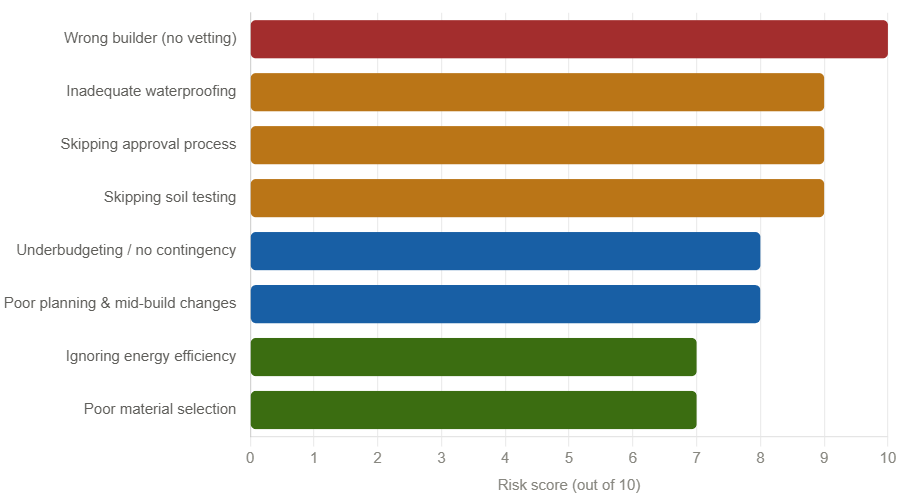
| # | Mistake | Build Stage | Risk Level | Potential Cost Impact |
|---|---|---|---|---|
| 1 | Skipping soil testing | Pre-construction | Very High | $15,000 to $50,000+ |
| 2 | Poor planning and mid-build changes | Design / Early Build | High | $10,000 to $40,000 |
| 3 | Ignoring energy efficiency and orientation | Design | Medium to High | $8,000 to $25,000+ lifetime |
| 4 | Choosing the wrong builder | Pre-construction | Very High | Entire project at risk |
| 5 | Inadequate waterproofing and drainage | Structural / Lock-up | High | $20,000 to $80,000 |
| 6 | Misunderstanding the approval process | Pre-construction | Very High | Legal penalties and demolition orders |
| 7 | Underbudgeting with no contingency | Pre-construction | High | Budget blowout of 15 to 30% |
| 8 | Poor material selection and substitution | Throughout build | Medium to High | $5,000 to $30,000+ |
Risk score out of 10 — based on frequency, financial impact, and difficulty of rectification
Mistake 1: Skipping Proper Soil Testing and Site Investigation
This is the one that stings the most, because it feels completely unnecessary until it very much is not. Soil testing, specifically a geotechnical investigation, tells you what is underneath your block before a single footing goes in.
In the ACT and surrounding NSW regions, you will encounter everything from Class A reactive soils through to highly reactive Class H and E profiles, particularly in areas like Gungahlin, Molonglo Valley, and parts of Queanbeyan. If you skip the soil test and your engineer designs a slab based on assumed site conditions, you could end up with a footing system that is completely undersized for the actual reactive clay sitting underneath your home. That leads to slab heave, cracking, and structural movement. Fixing it after the fact costs multiples of what the original test would have.
A proper geotechnical report typically costs between $1,500 and $3,000. Compare that to a reactive soil remediation bill, and the decision makes itself.
Key technical points to know:
Australian Standard AS 2870 governs residential slab and footing design based on soil classification
ACT soils frequently vary between Class M and Class H1 or H2 reactivity
Always commission a site-specific soil report, not a generic desk study based on nearby properties
Mistake 2: Poor Planning and Mid-Build Design Changes
Every single change you make after construction begins costs more than it would have cost at the design stage. This is called the cost of change curve, and in construction it is steep.
A door moved during drafting costs almost nothing. That same door moved after framing is complete can cost $1,500 to $3,000 once you factor in labour, materials, and the flow-on impact on electrical and plumbing rough-in. Homeowners in Canberra frequently underestimate how long the design and approval stage should take. Rushing through drawings, approving documentation without reading it carefully, and then changing direction during construction are three of the most expensive habits a homeowner can have.
Spend real time with your designer. Ask hard questions. Walk through the floor plan with a tape measure in hand. Think about how you actually live, not how you imagine you will live in a theoretical version of this house.
What to do instead:
Use detailed 3D modelling before finalising your design and committing to documentation
Review electrical, plumbing, and joinery layouts as separate line items
Freeze the design before DA submission wherever possible to avoid approval resubmission fees
If you are unsure what inclusions to lock in early, the home inclusions page at Virk Construction Management breaks down standard versus premium specification choices relevant to Canberra builds.
Mistake 3: Ignoring Energy Efficiency and Building Orientation
This one is specific to Canberra and it matters more here than almost anywhere else in Australia. The ACT has mandatory NatHERS energy rating requirements under the NCC, currently requiring a minimum 7-star rating for new homes. But meeting the minimum standard and actually designing for thermal performance are two very different things.
Building orientation is the foundation of passive solar design. A north-facing living zone with appropriate eave overhangs for Canberra's latitude of approximately 35 degrees south can dramatically reduce heating and cooling loads throughout the year. When builders or designers ignore orientation because of block shape or cost pressures, homeowners pay the price every single winter.
Common errors that are entirely preventable:
Living areas oriented south or east, missing valuable winter sun
Insufficient thermal mass in concrete slabs or brick walls
Undersized or absent roof overhangs that cause summer overheating
Poor window specification, particularly glazing U-values and Solar Heat Gain Coefficient (SHGC) ratings
A well-oriented, thermally comfortable home in the ACT can reduce energy bills by 30 to 50 percent compared to a poorly designed home of the same size. That is a significant financial saving that compounds over the life of the building.
Mistake 4: Choosing the Wrong Builder Without Proper Vetting
This is the most consequential of all the top construction mistakes in building a house, and it underpins every other mistake on this list. The right builder mitigates risks at every stage. The wrong builder amplifies every single one of them.
In Canberra and NSW, builders must hold a current licence issued by the ACT Building and Construction Industry Training Fund or a NSW Fair Trading contractor licence. You can and should verify this before signing anything. Check their registration status, look at their insurance certificates, ask for references from completed projects of similar scope, and actually call those references rather than just collecting them.
When you are comparing construction companies in Canberra, look past the polished website and ask the real questions: How do they handle variations? What is their payment claim process? Who is the site supervisor and how many concurrent projects are they managing?
One framework worth understanding before you sign any contract is the Cost Plus or Open Book model. Rather than a fixed lump sum with hidden margins baked in, a cost plus arrangement gives you full visibility over where every dollar goes. The Virk Construction Management Cost Plus model explains this approach in detail and it is worth reading carefully.
Mistake 5: Inadequate Waterproofing and Drainage
Water is patient. It will find every gap, every poorly sealed junction, every inadequate fall, and eventually it will cause damage. Waterproofing failures are among the most expensive defects to rectify in residential construction because they are often discovered late, after all the finishes are already installed.
In ACT and NSW, waterproofing of wet areas is governed by AS 3740, which sets minimum requirements for shower recesses, bathrooms, and laundries. But compliance with the minimum standard is not the same as good practice. Budget builders often apply single-coat membrane systems in wet areas when a two-coat system with proper cove details and bond breaker joints would significantly improve long-term durability.
External drainage is equally important. In Canberra, where summer storms can deliver significant rainfall over short periods, site drainage must be designed to direct stormwater away from the structure. Poor surface falls on paths, driveways, and landscaping can direct water toward the slab perimeter, leading to subfloor moisture, footing issues, and rising damp.
Technical checklist for waterproofing on your build:
Ensure all wet area membranes are independently inspected and signed off before tiling commences
Confirm shower hob heights and wall junctions have correct cove details as per AS 3740
Verify site drainage falls meet a minimum of 1 in 100 away from the building structure
Review stormwater connection compliance with ACT Environment, Planning and Sustainable Development Directorate (EPSDD) requirements
If you want to understand the technical detail around checking walls correctly, the Virk blog has a useful guide on how to check if a wall is perfectly flat, which covers the kind of quality control checks that catch waterproofing substrate problems early.
Mistake 6: Not Understanding or Following the Approval Process
Every new residential build in the ACT requires a Development Approval (DA) and a Building Approval (BA) before work can legally commence. Skipping or misunderstanding either of these stages is a serious construction mistake that can result in stop-work orders, monetary fines, and in extreme cases, demolition orders on non-compliant structures.
The DA process assesses your project against the ACT Planning Strategy and the Territory Plan. The BA process confirms the design meets the NCC and relevant Australian Standards. Both require properly prepared documentation including architectural drawings, structural engineering reports, energy efficiency assessments, and in some cases arborist or heritage impact statements.
Understanding what Established Ground Level (EGL) means for your specific site is a key part of getting DA documents right. The Virk blog has a clear explainer at What is EGL in Construction. Getting EGL wrong in your DA documentation can affect compliant floor levels, finished ceiling heights, and whether your proposed structure even fits within the territory plan building envelope rules.
Do not treat the approval process as an administrative formality. It is a technical exercise that requires the right professionals preparing the right documents from the start.
Mistake 7: Underbudgeting and Failing to Plan a Contingency
One of the most persistent and damaging construction mistakes is going into a build without a realistic budget and without a contingency reserve sitting separate and untouched. In Canberra, residential construction costs currently sit in the range of $2,500 to $4,500 per square metre depending on specification level, site conditions, and the type of builder engagement you choose.
The blog post on how much it costs to build a house in Canberra provides a detailed breakdown of how costs are distributed across trades, and it is worth reading in full before you finalise any budget figure.
The standard recommendation is to hold a minimum 10 percent contingency on your total contract value. Some project managers recommend 15 percent for projects with complex sites or significant custom scope. This contingency is not money you plan to spend. It is insurance against the unexpected: a variation from an unforeseen underground service, a material price escalation mid-build, or a subcontractor timeline blowout that increases site preliminary costs.
Homeowners who spend their contingency on upgrades before the build is complete and then encounter an unforeseen issue are the ones who end up in genuine financial distress. Protect the contingency.
Mistake 8: Poor Material Selection and Specification
Not all building materials perform equally, and the difference between a product that lasts 25 years and one that fails in 10 often comes down entirely to how the specification was written at the design stage. This is particularly true for external cladding, roofing, and wet area joinery.
In the ACT, bushfire risk is a real planning consideration. Bushfire Attack Level (BAL) ratings affect which materials can be legally used on your building, particularly for homes in outer Canberra, Murrumbateman, Bungendore, Hall, and surrounding rural interface areas. Using non-compliant cladding on a BAL-12.5 or higher rated site is not just a performance risk, it is a legal non-compliance that can void your insurance and trigger a rectification order.
For roofing and external cladding decisions relevant to the ACT climate and BAL requirements, the Virk Construction Management cladding options page outlines the most commonly specified products for Canberra builds and their relative performance characteristics.
Also worth reading at a more technical level is the Virk blog post on whether OPC or PPC cement is better for plastering, which gets into material selection detail relevant to internal finishes that most homeowners never think to ask about.
What to watch for in material specifications:
Never accept substitutions without written approval and confirmation of equivalent specification
Confirm all structural materials comply with relevant Australian Standards (steel to AS/NZS 3678, timber to AS 1720)
Verify that all waterproof membranes carry CodeMark or WaterMark certification before they are installed
Ensure external cladding complies with BAL rating requirements for your specific lot, not just the general area
Final Thoughts: Prevention is Always Cheaper Than Rectification
The top construction mistakes in building a house are almost never the result of bad luck. They are the result of rushed decisions, inadequate information, or simply not knowing what questions to ask before work begins. Building in Canberra, ACT, or the surrounding NSW region means working within a specific regulatory environment, a challenging climate, and a complex supply chain. Getting it right means preparing thoroughly before ground is ever broken.
The encouraging reality is that every mistake on this list is preventable. With the right builder, rigorous pre-construction preparation, thorough design documentation, and a realistic budget with contingency in place, a well-delivered new home in the ACT is entirely achievable without the costly errors that derail so many other projects.
Ready to Build Your Home in Canberra Without the Costly Mistakes?
Virk Construction Management is a licensed construction management firm based in Canberra, delivering residential and commercial projects throughout the ACT and NSW. They operate on an Open Book Cost Plus model, which means full transparency over your build budget with no hidden margins at any stage.
Whether you are planning a new single or double storey home, a knockdown rebuild, or a complex dual occupancy project, the team at Virk brings both technical depth and genuine accountability to every project from feasibility through to handover.
Get in touch with Virk Construction Management here and start your build conversation with a team that genuinely knows the Canberra market.
You can also explore their full construction services to understand the scope of what they manage, from planning and approvals through to site management and final quality audit.
Building a house is a massive undertaking. The difference between a smooth build and a stressful one often comes down entirely to the decisions made before a single sod is turned.